By Tim Wu, Sales Manager, Cheer Pilates Equipment
Short answer: Pilates equipment certification covers two different things. An ISO certificate is about the factory. It shows that the company runs an audited quality management system. A CE marking is about the product. It’s the manufacturer’s declaration that the product meets the EU requirements that apply to it. Ask a supplier for the actual documents, check that the company name on them matches the company you’re paying, and check which products they cover. Cheer Pilates Equipment runs an ISO certified factory, and our products are CE certified. No certificate replaces testing a sample in your own studio.
“Do you have certificates?” is one of the first questions in almost every inquiry we get. It’s a good question. But it’s often asked as a yes-or-no question, when the useful answer is more specific: which certificate, issued to whom, covering what.
This article explains what the two certificates buyers ask about most actually mean for Pilates equipment, and how to check them. We’ll also be honest about their limits.
Pilates equipment certification: the factory and the product
A lot of confusion comes from mixing these up.
Factory-level certification answers: does this company have a controlled, audited way of making things? That’s what ISO certification is about.
Product-level conformity answers: does this product meet the rules for the market it’s sold in? For the EU and many markets that follow EU rules, that’s where CE marking comes in.
A factory can have one without the other. You want to know about both.
What an ISO certified factory means
In plain terms
An ISO quality management certificate means an external certification body has audited how the company works. That covers how it controls processes, keeps records, handles complaints and fixes problems. The company is audited again at intervals to keep the certificate.
What it doesn’t mean
It doesn’t mean every product is perfect. It doesn’t certify a specific reformer model. And it doesn’t tell you how good the carriage feels or how long the upholstery lasts. It tells you there’s a system for catching and correcting problems.
What to ask for
- A copy of the certificate
- The name of the certification body
- The company name and address on the certificate
- The scope: what activities it covers
- The validity dates
Our factory in Ningjin, Shandong, is ISO certified. Beijing Cheer Fitness Equipment Co., Ltd. holds ISO 9001:2015 certification, and we send a copy of the certificate on request.
What CE marking means for Pilates equipment
In plain terms
CE marking is how a manufacturer declares that a product meets the EU legal requirements that apply to it. Products that fall under these rules need it to be sold in the European Economic Area. Many buyers outside Europe also use it as a reference point.
What to ask for
- The CE certificate or Declaration of Conformity
- Which products or models it covers
- Which standards or directives it refers to
- The company name on the document
Our products are CE certified. CE documents can be provided by model on request.
A common problem
A known problem in our industry: a “CE certificate” that turns out to be for a different company, a different product, or a document bought online without any real assessment behind it. Check the name and the product list. If either doesn’t match, ask questions.
EU GPSR attestation (ECM)
Beijing Cheer Fitness Equipment Co., Ltd. holds an EU GPSR attestation issued by Ente Certificazione Macchine Srl (ECM, Italy). This is a GPSR attestation, not a CE certificate. You can read the full document below.
- Attestation No.: 1N250218.BCF0W92
- Technical construction file: TCF2025012166GPSR
- Issued by: Ente Certificazione Macchine Srl (Italy)
- Holder: Beijing Cheer Fitness Equipment Co., Ltd.
- Standards: EN ISO 20957-1:2013 and EN ISO 20957-2:2021, related to Regulation (EU) 2023/988 on General Product Safety (GPSR)
- Issued: 18 February 2025. Expires: 17 February 2030
- Models covered (as listed in the annex): CP101–CP110, CP151–CP160, CP201–CP210, CP301–CP310, CP321–CP330, CP341–CP350, CP361–CP370, CP501–CP510, CP521–CP530, CP541–CP550 and CR101–CR190
What it covers, honestly: this is a voluntary attestation issued under a non-notified procedure. ECM verified our technical documentation; it did not test the products. It does not replace an EC Declaration of Conformity, and it applies only to the models listed in its annex.
Download the ECM GPSR attestation (PDF)
Certificates we don’t claim
We prefer to be clear about this. We list ISO for our factory and CE for our products. We don’t list other social or audit certifications on our website, and we’d rather tell you that directly than put a row of logos on a page.
If your customer or tender requires a specific certificate or audit, tell us early. We’ll tell you honestly whether we have it.
What no certificate can tell you
Certificates are a minimum. They don’t tell you:
- How smooth the carriage is after a year of classes
- How the springs feel to an experienced instructor
- How well the upholstery stands up to sweat and cleaning
- How carefully this particular batch was assembled
- How the supplier handles problems
For that you need a sample, references and a clear QC process.
How we check machines before they leave
At our factory, every machine is inspected before packing. Certificates describe a system. These checks are what that system looks like on the floor.
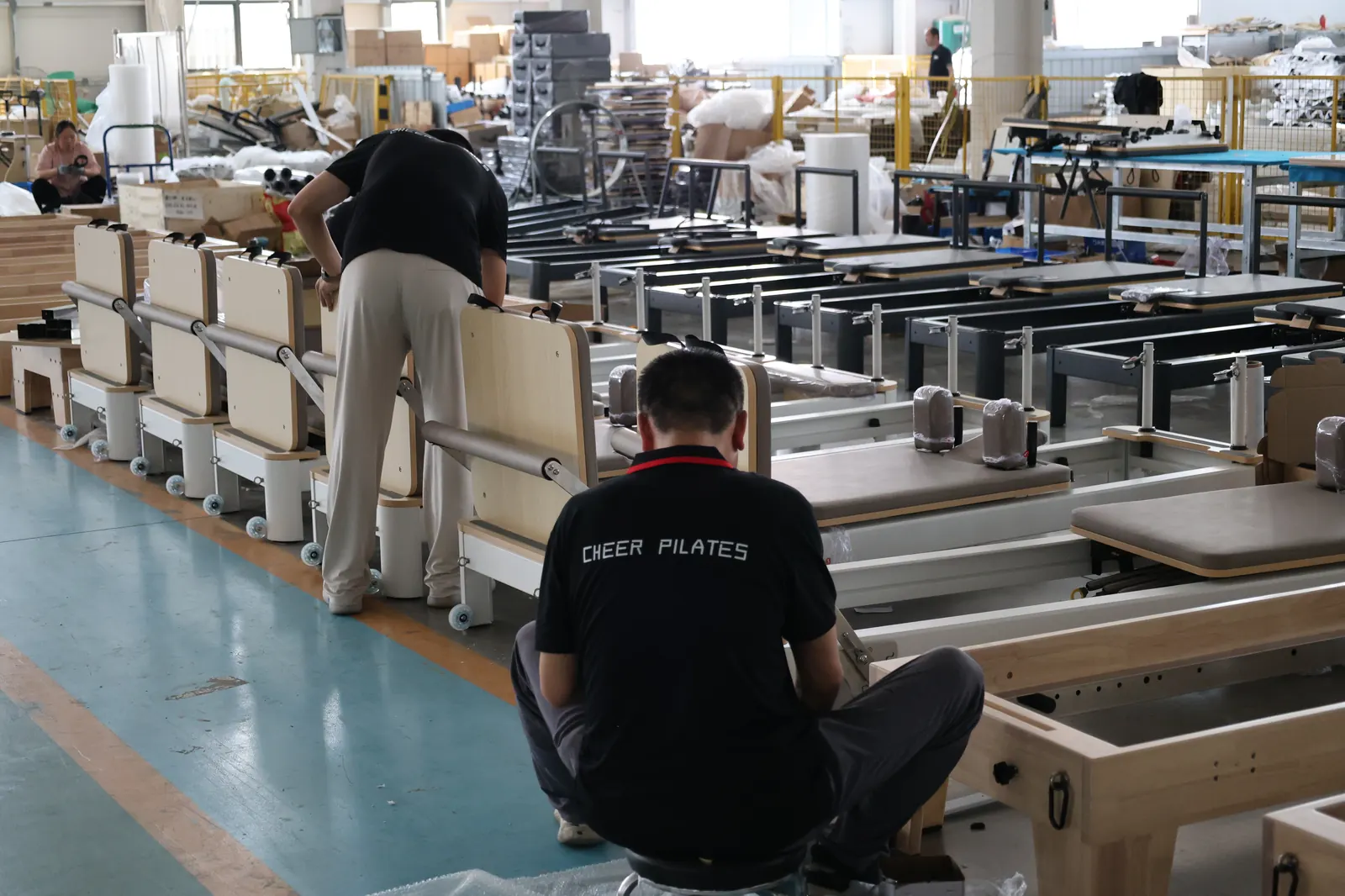
Our OEM page lists the checks we run: incoming material inspection for aluminum, steel, wood and leather; machining with tolerance control; static and dynamic load tests on every reformer; carriage smoothness and noise tests; spring fatigue testing; and a final inspection before packing.
If you want a third-party inspection before shipment, arrange it with the inspection company you trust and we’ll cooperate with them.
A sample is the best test
Standard models are available from 1 unit, so you can test one before you commit. We can even add your logo to that single unit. Put it in a studio for a few weeks. Instructors will tell you more than any certificate.
How to check a supplier’s certificates in five minutes
- Match the name. The certificate, contract and bank account should name the same company.
- Check the dates. Is the certificate still valid?
- Check the scope. Does it cover making fitness or Pilates equipment, or something unrelated?
- Check the issuer. Is it a recognized certification body? Look it up. Many accredited ISO certificates can be searched on IAF CertSearch.
- Ask for the product list. For CE, are your models on it?
If a supplier won’t send documents, or the names don’t match, treat any certification claim on their website with caution.
If you sell outside Europe
CE is an EU system. Many buyers in other regions ask for it because it’s familiar, and it’s a useful reference. But your country may have its own rules for fitness equipment, labeling or import documents.
Our advice: before your first order, ask your customs broker or importer which documents your market needs. Then send us that list. It’s much easier to prepare paperwork before production than to chase it while the goods sit at the port.
For buyers outside the EU, we can also provide SGS and TÜV test reports.
Documents to keep after delivery
Once the machines arrive, keep a simple file for each order:
- Commercial invoice and packing list
- Certificates and declarations you received
- Model numbers, and serial numbers if marked (our standard machines don’t carry serial numbers; for distributor orders we can add them)
- Photos of the machines on arrival
- Your warranty terms
If a customer, insurer or inspector asks questions two years later, you’ll have the answers in one place.
What this means if you’re a distributor
If you resell equipment, your customers may ask you for certificates. Clinics and hotels especially. Ask your supplier for:
- Certificates in a format you can share
- Product documents with model numbers
- Permission to mention the certificates in your marketing
For distributors, we provide copies of our certificates and test reports, product documents with model numbers, and on request customized instruction manuals, product nameplates and installation videos.
For tenders and large projects
Hotels, gyms and public facilities sometimes buy through tenders with document requirements. Send us the requirements as soon as you have them, not a week before the deadline. Some documents take time to prepare.
Our OEM and ODM page explains how we handle larger projects.
Frequently asked questions
What’s the difference between ISO and CE for Pilates equipment?
ISO certification is about the company’s quality management system. CE marking is about the product meeting the EU requirements that apply to it. They answer different questions, so it’s useful to have both.
Is Cheer Pilates Equipment certified?
Yes. Our factory is ISO certified and our products are CE certified.
How do I know if a supplier’s certificate is real?
Check that the company name matches your contract and bank account, check the dates and scope, look up the issuing body, and for CE ask which products are covered.
Does CE certification mean the reformer is high quality?
Not by itself. CE shows the product meets the requirements that apply to it. Comfort, smoothness and durability depend on design, components and assembly. Test a sample.
Can I get copies of your certificates?
Yes. We send copies on request. For buyers outside the EU, we can also provide SGS and TÜV test reports.
Do you have other certifications?
We list ISO for our factory and CE for our products. If you need something specific for a tender, ask us and we’ll answer honestly.
Ask us for documents
If you’re preparing a purchase, a resale or a tender, tell us which Pilates equipment certification documents you need and for which models. Model numbers are listed on each product page, for example the CP304 aluminum reformer with half tower or the CP322 oak full tower reformer.
Read more about our company, our FAQ, or the distributor program.
Tim Wu is Sales Manager at Cheer Pilates Equipment and has worked in the fitness and Pilates equipment industry for 10 years. He handles export projects for studios, distributors and private-label brands, and you can reach him directly on +86 177 5347 9797.