By Tim Wu, Sales Manager, Cheer Pilates Equipment
Short answer: For a Pilates studio layout, divide the length of the wall you’re lining machines along by the machine width plus the gap you want between machines. Check that the room depth fits the machine length plus a walkway. Reformer width matters more than most people expect. In an 8 m long room, with about 1 m between machines, a 63 cm-wide reformer fits 4 stations where a 92 cm-wide model fits 3. Measure your doors and lifts too, because a 2.4–2.6 m carton has to get into the room first.
Studio owners often send us a quick sketch and ask, “How many reformers can I fit?” It’s a fair question, and one that should be answered before choosing a model, not after. The model you pick changes the answer.
This guide walks through the simple calculation we use, with real machine sizes from our own range. We recommend about 1 m between machines. Your instructors, your local rules and your class style may call for more.
Pilates studio layout: start with the numbers that matter
You need four measurements of the room:
- Length of the wall you’ll line the machines along
- Depth of the room from that wall
- Clear ceiling height, if you’re considering tower models
- Door and route sizes for getting cartons in
And three numbers for each machine:
- Width
- Length
- Height (mostly relevant for towers)
Real machine sizes from our range
| Model | Type | Length | Width | Height |
|---|---|---|---|---|
| CP167 | Maple reformer | 249 cm | 63 cm | 38 cm |
| CP168 | Maple reformer | 229 cm | 69 cm | 38 cm |
| CP124 | Aluminum reformer | 249 cm | 69.5 cm | 42.5 cm |
| CP125 | Aluminum full track | 238 cm | 82 cm | 38 cm |
| CP108 | Aluminum, sliding footbar | 240 cm | 92 cm | 38 cm |
| CP310 | Aluminum + half tower | 259 cm | 69.5 cm | 201.5 cm |
| CP321 | Maple + full tower | 248 cm | 77 cm | 205 cm |
All sizes are from our product pages. Check your exact model before you finalize.
Look at the width column. The difference between 63 cm and 92 cm is almost 30 cm per machine. Across a row of machines, that adds up to whole stations. The CP108 (92 cm) and CP125 (82 cm) figures are overall widths. The extra width comes from their wide foot bar design, not from a wider carriage or frame. For spacing, the overall width is what counts.
The spacing we use
For the worked examples below, we’ve used:
- About 1 m between machines and between the end machines and the side walls
- 60 cm behind the head end of each machine
- About 1 m walkway at the foot end, or between two rows
About 1 m between machines is our recommendation. Some studios want more room for instructors to move between machines, and local regulations may also apply. The 60 cm behind the head end is an example figure; adjust it to your room.
The calculation
Stations in a row = (wall length − one gap) ÷ (machine width + one gap), rounded down
Rows that fit = check if room depth ≥ machine length + head gap + walkway (one row), or ≥ 2 × machine length + 2 × head gap + walkway (two rows facing each other, foot ends towards the shared walkway)
That’s it. It’s simple, but it stops you from buying a model that doesn’t fit the room you have.
Worked example 1: small room, 6 × 4.5 m
- CP167 (63 cm): (6.0 − 1.0) ÷ (0.63 + 1.0) = 3.1 → 3 stations
- CP124 (69.5 cm): 5.0 ÷ 1.695 = 2.9 → 2 stations
- CP125 (82 cm): 5.0 ÷ 1.82 = 2.7 → 2 stations
- CP108 (92 cm): 5.0 ÷ 1.92 = 2.6 → 2 stations
Depth check: 2.49 m machine + 0.6 m + 1.0 m walkway = 4.09 m. That fits in 4.5 m, so one row.
Worked example 2: medium room, 8 × 6 m
- CP167: 7.0 ÷ 1.63 = 4.3 → 4 stations
- CP124: 7.0 ÷ 1.695 = 4.1 → 4 stations
- CP125: 7.0 ÷ 1.82 = 3.8 → 3 stations
- CP108: 7.0 ÷ 1.92 = 3.6 → 3 stations
Depth check: two rows would need about 7.2 m. At 6 m deep, that’s one row. The leftover depth is useful for chairs, barrels or a storage wall.
This is where model choice matters most. In this room, a 63 cm reformer gives you 4 stations and a 92 cm reformer gives 3. If you sell group classes, that’s one extra spot in every class.
Worked example 3: larger room, 10 × 8 m
- CP167: 9.0 ÷ 1.63 = 5.5 → 5 per row
- CP125: 9.0 ÷ 1.82 = 4.9 → 4 per row
Depth check: 2 × 2.49 + 2 × 0.6 + 1.0 = 7.18 m. That fits in 8 m, so two rows: 10 stations with CP167, 8 with CP125.
Don’t choose on width alone
A narrower reformer isn’t automatically better. Compare the track, the footbar and the accessories too, and pick the model that suits your classes. Then check it fits the room.
Our honest advice: decide what your classes need first. Then use the width to work out how many fit. If two models are both right for your classes, the narrower one usually lets you sell more spots.
Towers: check the ceiling
Tower reformers like the CP310 (201.5 cm) and CP321 (205 cm) need ceiling clearance well above their height. Exercises and instructors need room above the tower too. We recommend a clear ceiling height of at least 2.6 m for tower reformers and Cadillacs.
Also look up: ceiling fans, hanging lights, sprinkler heads and air-conditioning units can all get in the way. Place tower machines where the ceiling is clear.
A layout tip: put tower reformers along a wall, with the tower end against it. They’re less in the way there, and the room feels more open.
Small equipment fits the gaps
Chairs and barrels don’t need much space. Our stability chairs, like the CP501, are 75 × 69 × 61 cm. They fit along a wall or in the leftover depth from the examples above.
Getting machines into the room
Floor planning isn’t only about where machines stand. They have to get there first.
Most of our reformer cartons are around 2.4–2.65 m long. Before you order:
- Measure doors, corridors and turns on the route
- Check lift depth and door width, if the studio isn’t on the ground floor
- Ask whether a tail-lift truck can reach the entrance
- Plan for two or more people at delivery
If access is tight, a folding reformer or a model that ships in two cartons may be the better choice. Our CP201 folding aluminum reformer, for example, is 244 × 68 × 28 cm and packs into 0.6 CBM.
Leave room for the business, too
A room full of machines isn’t a studio yet. Leave space for:
- An instructor’s position where everyone can see them
- Storage for props, springs and cleaning supplies
- Clients arriving, leaving and putting their things down
- Cleaning between classes
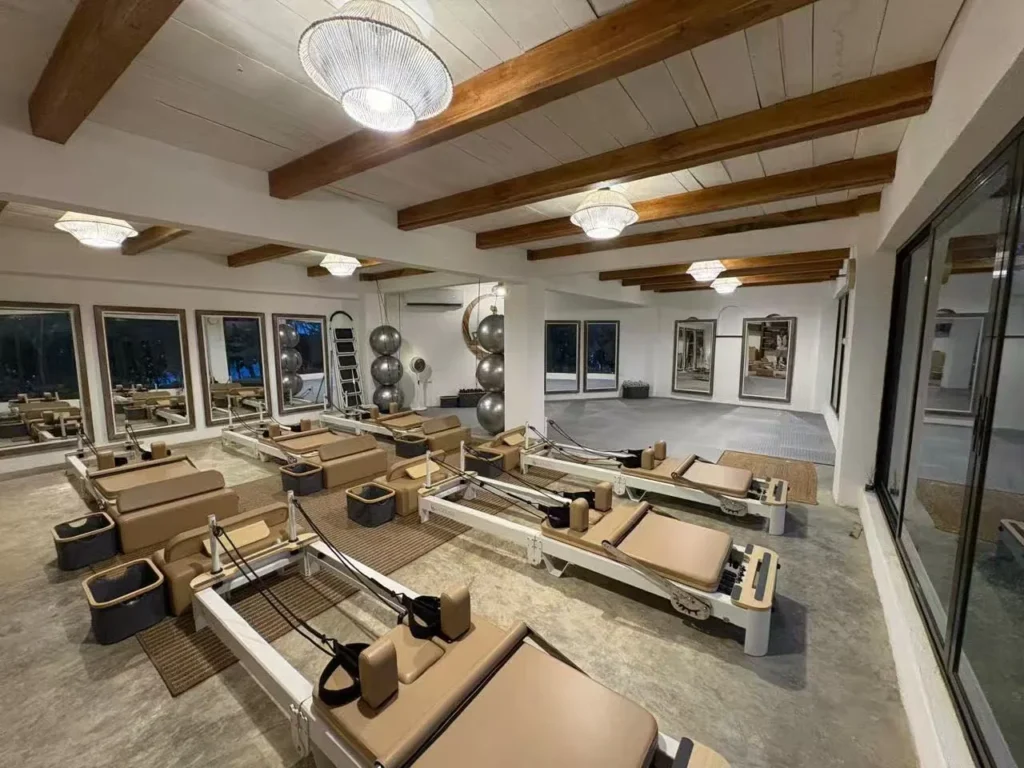
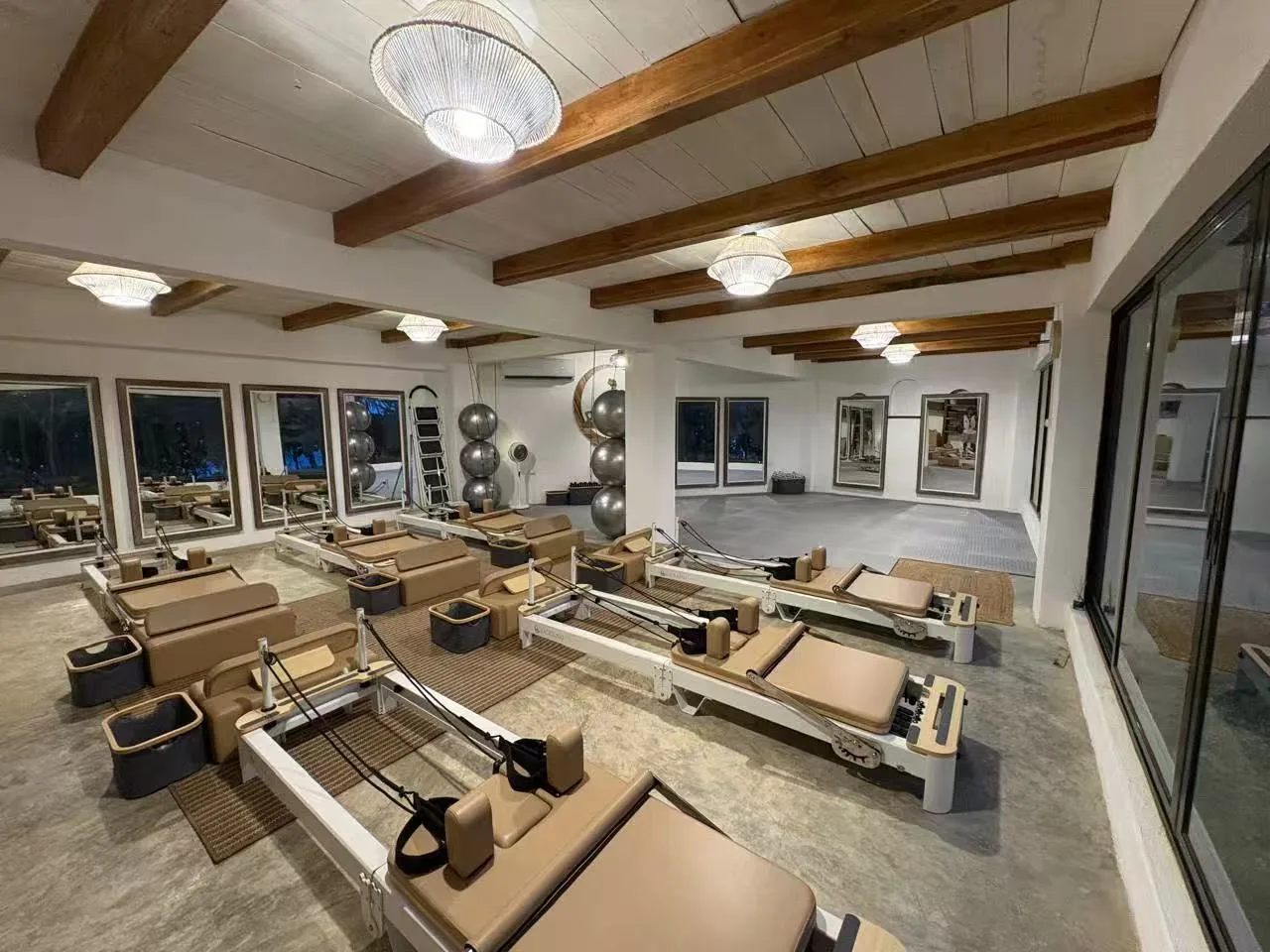
Here’s one real room. A studio in Costa Rica set up its main space with rows of our white aluminum folding reformers and kept an open floor area beside them.
Let us check your plan
Send us your room dimensions, ceiling height, door sizes and the classes you plan to run. Our team can suggest models and a Pilates studio layout to match. The best places to start are our studio solutions page and the studio setup plan inquiry form.
Frequently asked questions
How much space does one Pilates reformer need?
The machine itself is roughly 2.3–2.6 m long and 0.63–0.92 m wide in our range. Add space between machines and a walkway at the foot end. We recommend about 1 m between machines and a walkway of about 1 m.
How many reformers fit in a 50 m² room?
It depends on the room’s shape, not just its area. Use the formula above with your real wall length and depth. In our 8 × 6 m example (48 m²), 3 to 4 reformers fit in one row, depending on model width.
What ceiling height do tower reformers need?
Our tower reformers are about 2.0–2.05 m tall. You need clearance above that for exercises. Check for fans and lights before placing them.
Is a narrower reformer worse?
Not necessarily. Choose the model that suits your classes first, then compare widths. A narrower model like the 63 cm CP167 can add stations in the same room.
Will a reformer fit through my door?
Check the carton size on the product page. Most reformer cartons are 2.4–2.65 m long, so the route matters as much as the door width.
Get a layout and quote
Tell us your room size, ceiling height, access route and preferred machines. We’ll come back with a suggested layout and a quote.
See the CP167 maple reformer, the CP310 half tower reformer, or browse all products.
Tim Wu is Sales Manager at Cheer Pilates Equipment and has worked in the fitness and Pilates equipment industry for 10 years. He handles export projects for studios, distributors and private-label brands, and you can reach him directly on +86 177 5347 9797.