
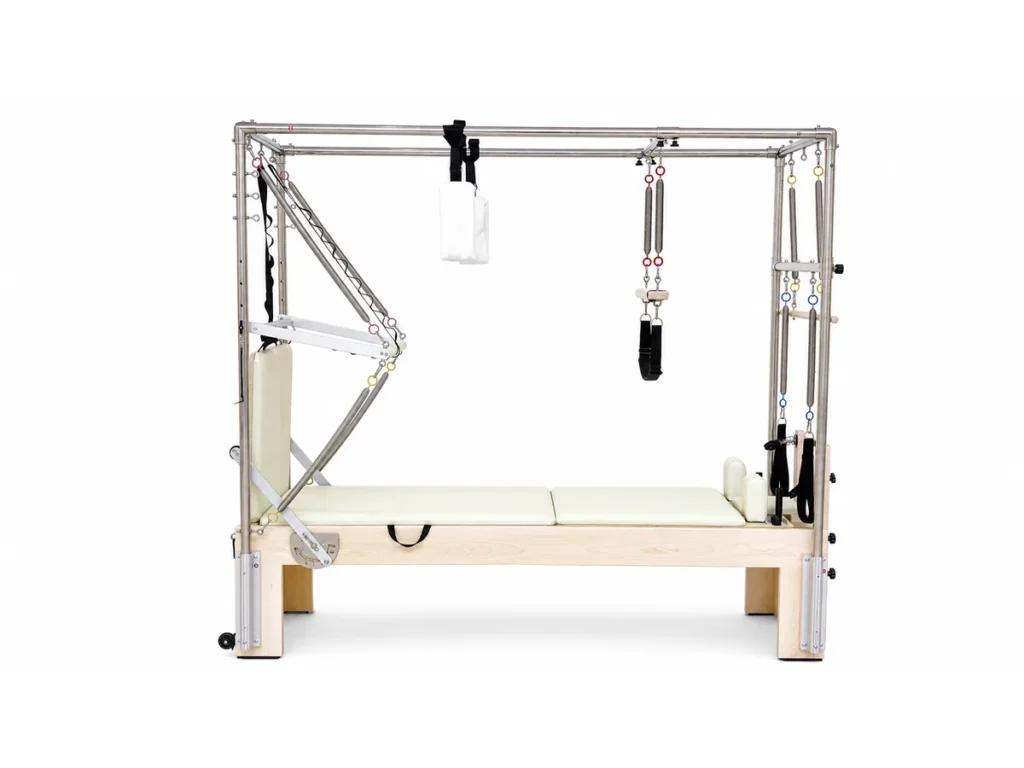
Short answer: the main Pilates studio machines are the reformer, the tower reformer (half trap or full trap), the Cadillac or trapeze table, the wall unit, the Wunda chair, the ladder barrel and the spine corrector. Most studios open with a room of reformers and add the rest as private sessions and new class types grow.
Names are where a lot of first quotes go wrong. One supplier writes “trap table”, another writes “Cadillac”, a third writes “trapeze bed”, and the buyer ends up comparing three prices for what looks like three machines. It is the same machine. I have spent ten years building quote lists with studio owners and importers, so here is the glossary I wish every buyer had before the first email: what each machine is called, what it does in a studio, and which ones to buy first.
Quick reference: Pilates machine names at a glance
| Machine | Also called | Main use in a studio | Cheer range |
|---|---|---|---|
| Reformer | Pilates bed, reformer bed | Group and private classes; the core of most timetables | Aluminum, wood, Mega, folding |
| Half trap reformer | Reformer with half tower, tower reformer | Reformer classes plus upright spring and bar work | CP301–CP312 |
| Full trap reformer | Reformer with full tower, combination reformer | Reformer work and most Cadillac work on one frame | CP321–CP325, CP332 |
| Cadillac | Trapeze table, trap table | Private sessions with springs, bars and a trapeze | CP341–CP346, CP350 |
| Wall unit | Wall tower, wall board | Tower-style spring work with almost no floor space | CP361, CP362 |
| Wunda chair | Pilates chair, stability chair, step chair | Seated and standing strength and balance work | CP501–CP511 |
| Ladder barrel | Barrel | Stretching, extension and side work | CP521–CP529 |
| Spine corrector | Step barrel, arc barrel | Spinal mobility on the floor or mat | CP541–CP545 |
Reformer
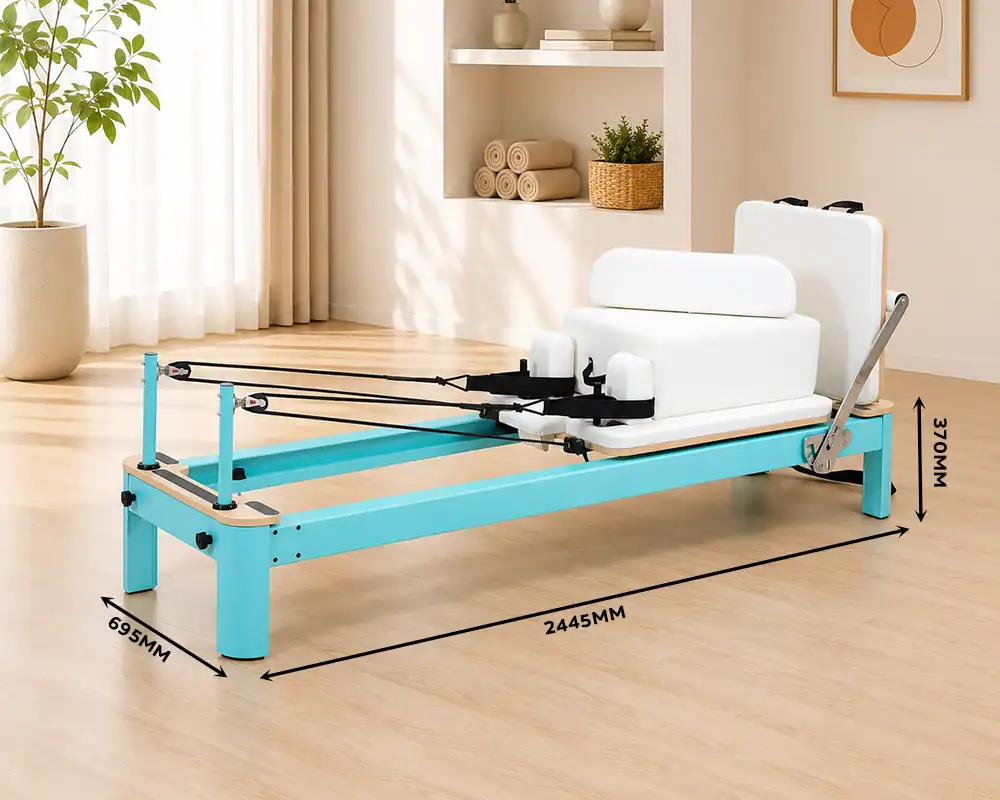
A reformer is a frame with a sliding carriage, springs for resistance, a footbar at one end and ropes or straps for the hands and feet. It is the machine most people picture when they hear “Pilates studio”, and it carries the group-class timetable in almost every studio we supply. If you are new to it, start with our explainer on what a Pilates reformer is.
The variants mostly differ by frame material and use:
- Aluminum reformers (the CP101 range): light, easy to move and clean, popular for busy group rooms.
- Wooden reformers in maple, oak, beech and red oak (CP151–CP170), built in our own wood workshop. Warmer to look at; many boutique studios choose them for that reason alone.
- Mega reformers (CP110–CP119). CP110, for example, has an aluminum alloy and steel frame.
- Folding and pull-out reformers (CP201–CP208, CP221–CP223 and the CP203 pull-out): for small rooms, home use and spaces that change through the day.
Our spring-loaded models use German Wagner springs. You can compare the full line-up on our commercial Pilates reformers page.
Half trap and full trap reformers (tower reformers)
A half trap reformer is a reformer with an upright frame, the tower, fixed at the head end. The tower adds springs and a push-through bar, so clients can do standing and spring work that a plain reformer cannot. A full trap reformer goes further: a full overhead frame over the whole reformer, which lets one machine handle most Cadillac exercises while keeping the moving carriage.
Cheer makes half trap models from CP301 to CP312, in wood and aluminum, and full trap models CP321–CP325 in wood plus an aluminum full-tower model, CP332. For a side-by-side comparison of size and use, read reformer vs half tower vs Cadillac.
Cadillac (trapeze table)
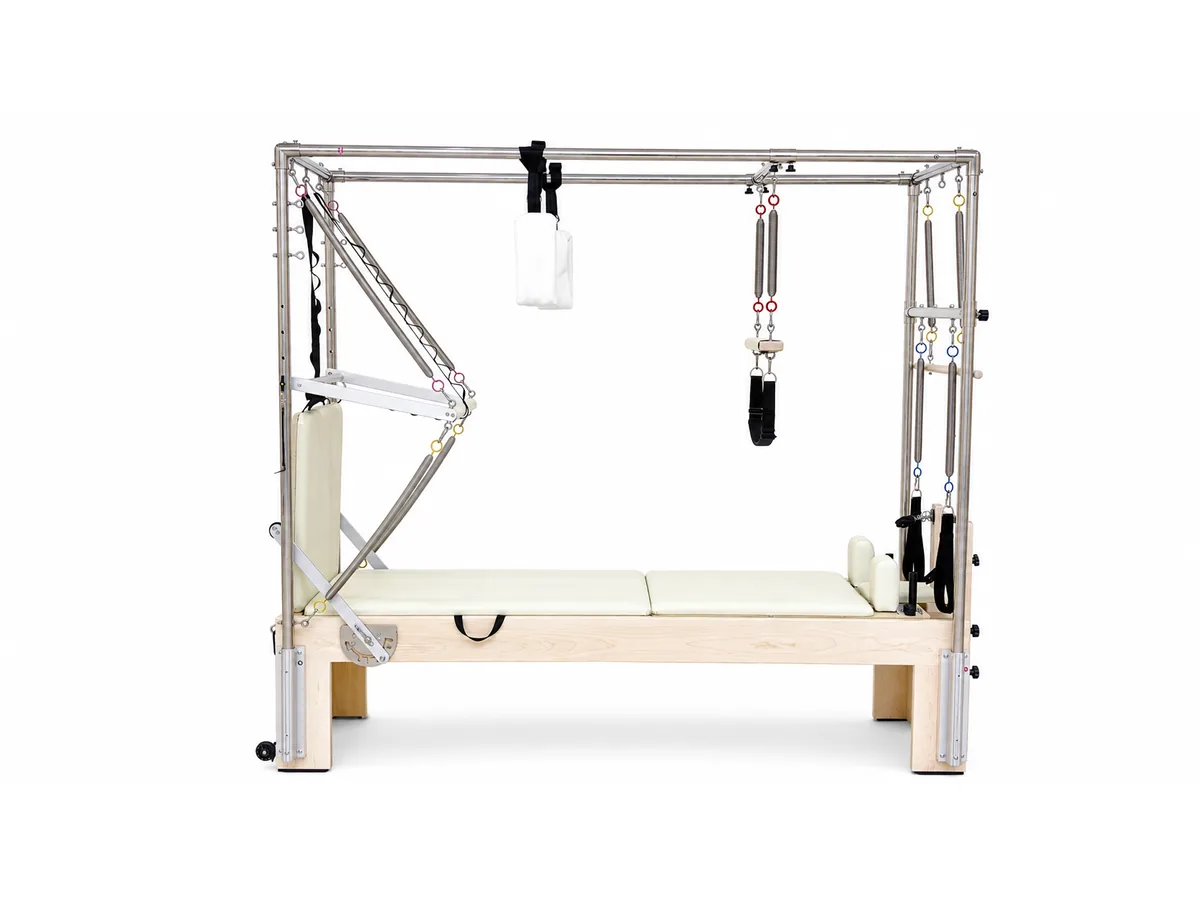
A Cadillac, also called a trapeze table, is a raised, fixed table inside a four-post frame. There is no moving carriage. Instead, the frame carries springs, a push-through bar, a roll-down bar and a hanging trapeze. Instructors use it for private and small-group sessions where the client needs support, or wants to work hanging, lying or kneeling with springs from above.
It is the biggest machine in most studios and the slowest to earn back its floor space. Our range covers CP341–CP346 in maple, oak, powder-coated and metal frames, plus CP350, an integrated VersaCore Cadillac. See our Pilates Cadillac tables.
Wall unit and core ladder
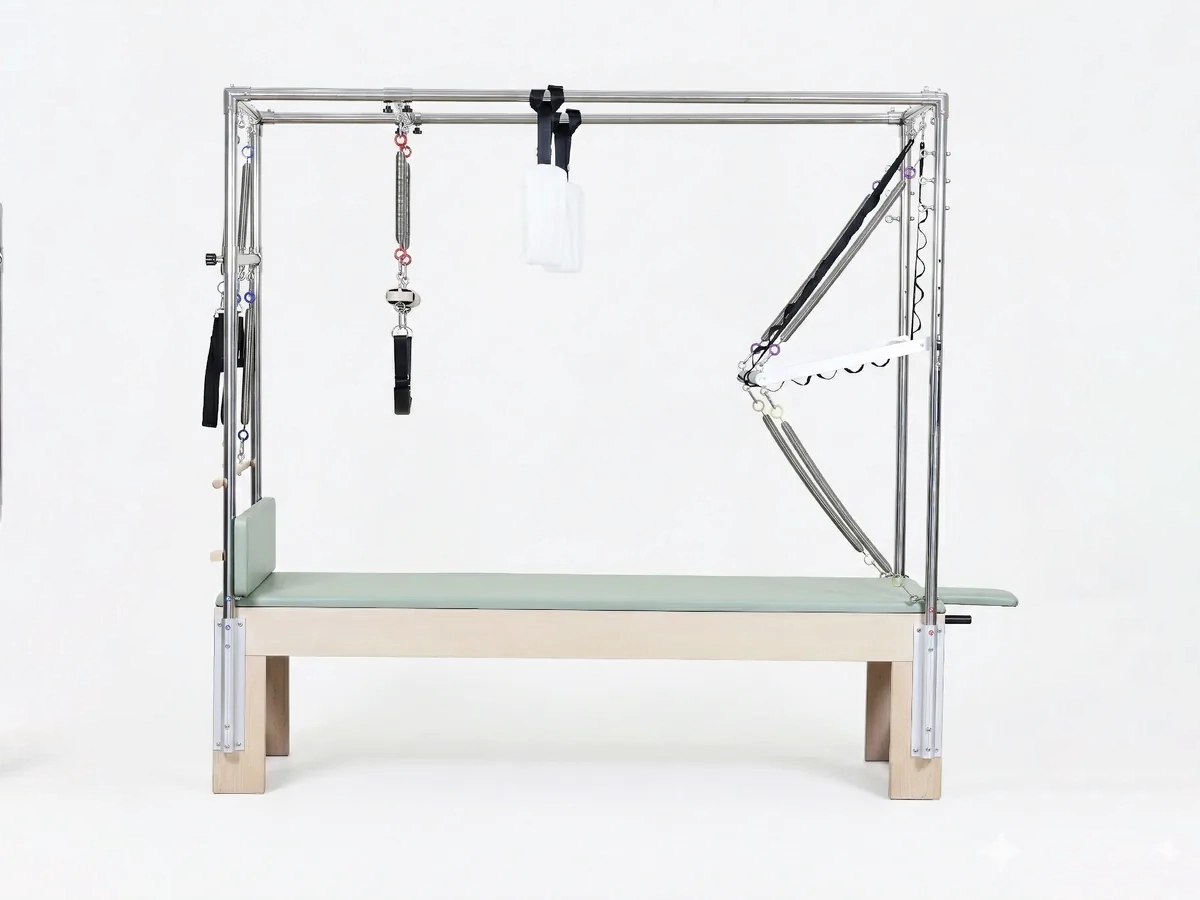
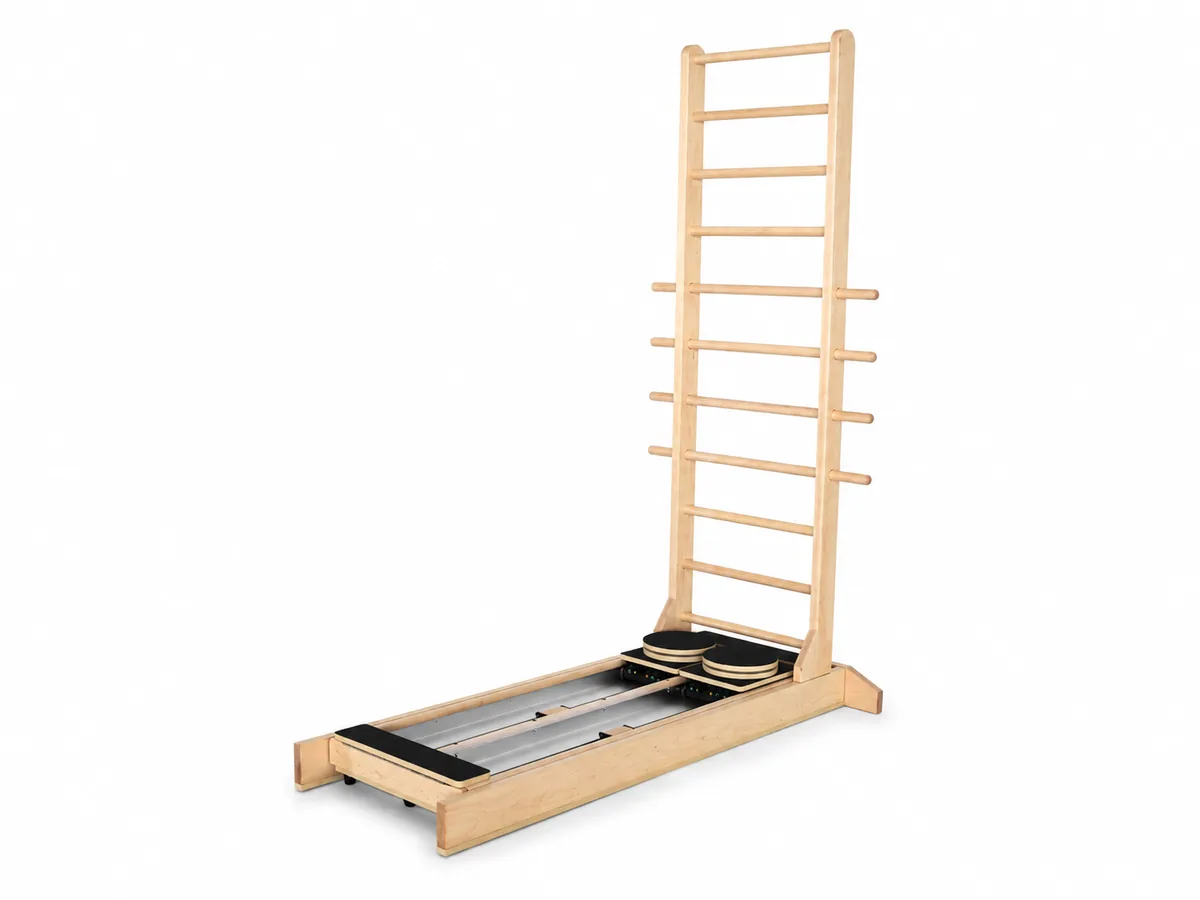
A wall unit is a board fixed to the wall with springs, a push-through bar and a roll-down bar. It gives you much of the tower work using a few square metres of wall. For small studios and rooms with a mat timetable, it is the simplest way to add spring work without losing floor space. Cheer makes the CP361 maple wall unit and the CP362 wall unit tower.
The CP364 core ladder is a related piece: a maple ladder frame with a low platform at its base, used for stretching and ladder work in movement studios.
Wunda chair
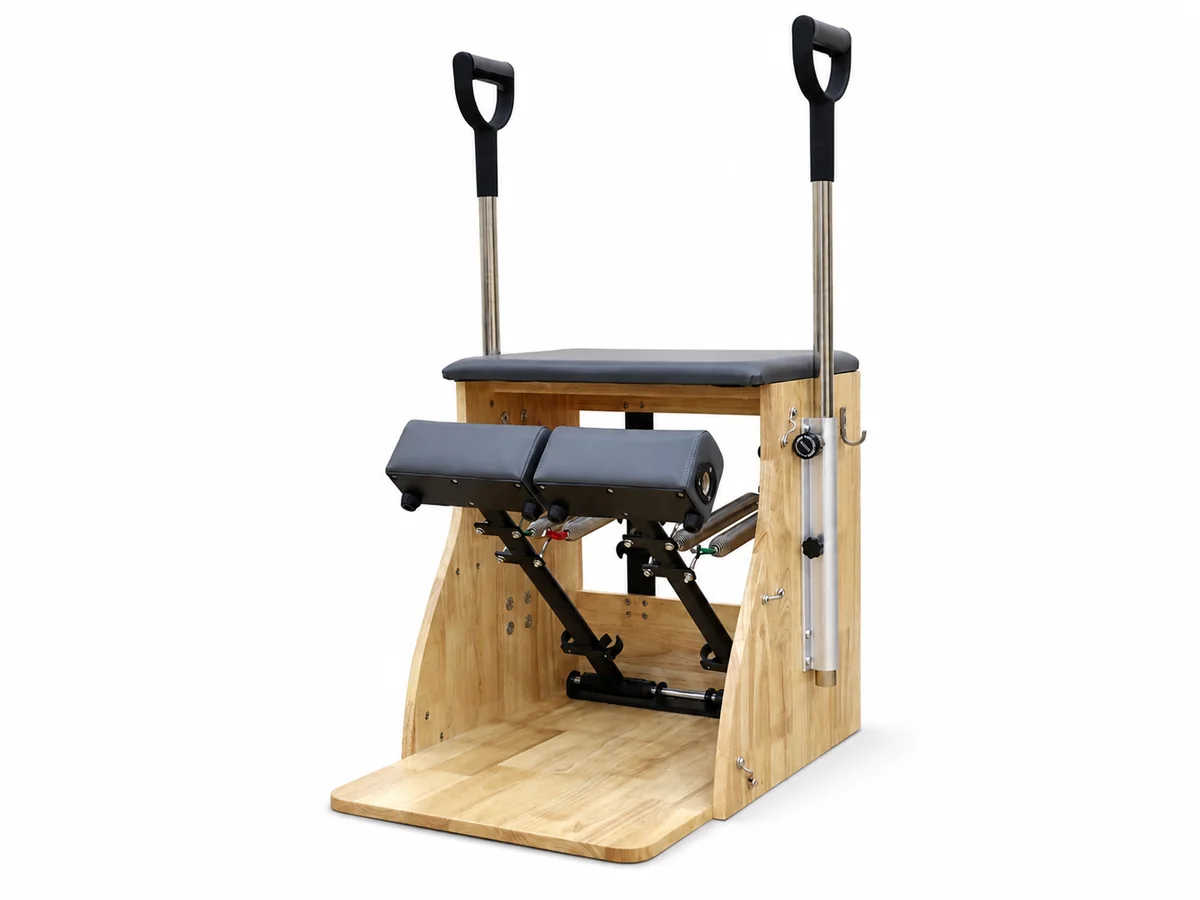
The Wunda chair is a small box with a spring-loaded pedal, sometimes split into two pedals, and on many models a pair of handles. Clients sit, stand, kneel or lie on it to press the pedal down against the springs. It is excellent for balance and strength work, and it takes up the least floor space of any spring machine.
Cheer’s Wunda chairs run from CP501 to CP511, in oak, beech, maple and red oak, powder-coated and steel-frame versions, and full-steel models. Browse our Pilates chairs and barrels.
Ladder barrel
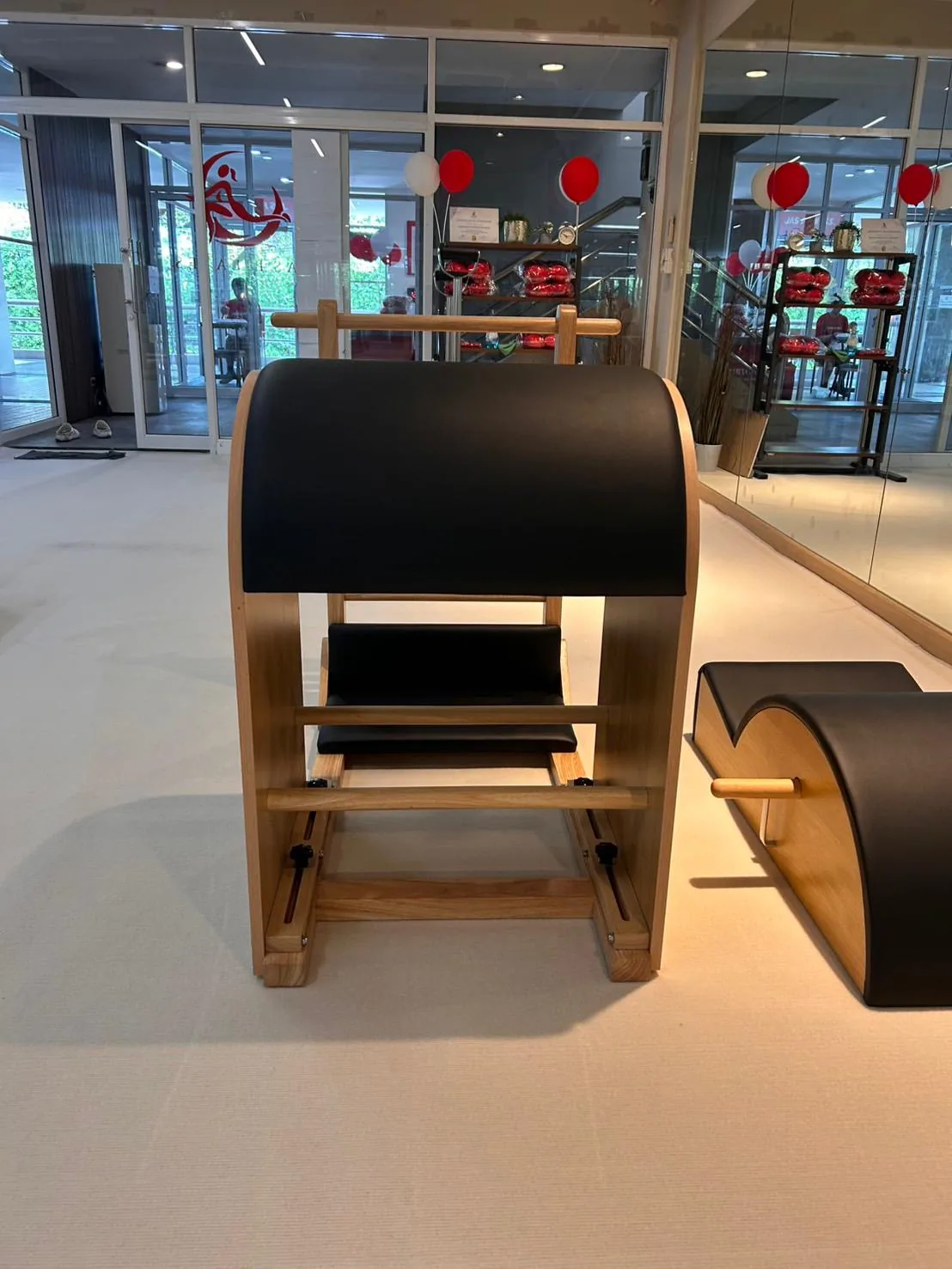
A ladder barrel joins a curved, padded barrel to a short wooden ladder, with an adjustable base between them. Clients hook their feet in the ladder and work over the barrel: stretching, back extension and side bending. It is a classic private-session piece and one of the first machines instructors ask for after reformers.
Our ladder barrels are CP521–CP529, in oak, beech and maple, a powder-coated version and full-steel models.
Spine corrector
A spine corrector is a smaller arc-shaped barrel with a low step on one side. It sits on the floor or a mat and supports the spine for mobility and stretching work. Because it is light and easy to store, many studios buy several for mat classes. Cheer’s spine correctors are CP541–CP544 in oak, maple, powder coating and EVA, plus CP545, a large upholstered wedge.
Other apparatus you will see in studio catalogues
Some machines sit outside the classic list. We describe them by what they do, not by trademarked method names:
- Maple pulley tower (CP381): rotational movement equipment that works with pulleys and counterweights, not springs.
- Metal pulley tower (CP386): a steel tower for pulley-based work.
- Jumping stretching board (CP382), archway (CP383) and leg extension unit (CP385): specialist pieces for movement studios.
My advice: treat these as add-ons for studios with a clear class idea behind them. They rarely belong in an opening order.
Which Pilates machines should a new studio buy first?
Buy reformers first. They run your group classes and earn most of the revenue. If the room allows, make one or two of them half trap reformers, so instructors can teach standing and spring work from day one. Add a Wunda chair and a ladder barrel next. Leave the Cadillac until private sessions need it and you have the space.
We don’t recommend opening with one of everything. A studio with ten reformers and full classes is in a far better place than a studio with one of each machine and an empty timetable.
| Machine | Floor-space note | When to buy |
|---|---|---|
| Reformer | One machine’s length plus room to step around it | Opening order |
| Half trap reformer | Same footprint as a reformer, more height | Opening order (1–2 units) |
| Wunda chair | Smallest footprint of any spring machine | First expansion |
| Ladder barrel | Medium; needs space at both ends | First expansion |
| Spine corrector | Stores on a shelf | Opening order, for mat classes |
| Wall unit | Almost no floor space; needs a solid wall | When the room is small |
| Cadillac | Largest footprint, with access on all sides | When private sessions are full |
For ready-made combinations by room size, see our Pilates studio equipment packages.
Buying the full range from one factory
Cheer Pilates Equipment is made by Beijing Cheer Fitness Equipment Co., Ltd., founded in 2015. We build the full studio range in one factory, from reformers to Cadillacs, chairs and barrels, and ship to 80+ countries. Cheer holds CE and ISO 9001. You can mix models in one order, starting from one unit, so a new studio can source every machine from one supplier and receive one shipment.
Frequently asked questions
What are the main Pilates studio machines called?
The core machines are the reformer, the tower reformer (half trap or full trap), the Cadillac (also called a trapeze table), the wall unit, the Wunda chair, the ladder barrel and the spine corrector. Most studios open with reformers for group classes and add the Cadillac, chair and barrels as private sessions and demand grow.
What is the difference between a half trap reformer, a full trap reformer and a Cadillac?
A half trap reformer adds an upright tower with springs and a push-through bar at one end of a reformer. A full trap reformer adds a full overhead frame, so it can do most Cadillac work while keeping the moving carriage. A Cadillac is a fixed, raised table inside a four-post frame, with no carriage.
Which Pilates machines should a new studio buy first?
Buy reformers first, because they run your group classes and earn most of the revenue. If space allows, make one or two of them half trap reformers for standing and spring work. Add a Wunda chair and a ladder barrel next, and leave the Cadillac until private sessions need it and you have the floor space.
What are a Wunda chair, a ladder barrel and a spine corrector used for?
The Wunda chair is a small box with a spring-loaded pedal, used for strength and balance work in seated and standing positions. The ladder barrel combines a curved barrel with a ladder, for stretching and back extension. The spine corrector is a smaller curved barrel used on the floor or a mat for spinal mobility.
Can I buy reformers, Cadillacs, chairs and barrels from one factory in one order?
Yes. Cheer makes the full studio range, from aluminum and wooden reformers to trap reformers, Cadillacs, wall units, Wunda chairs, ladder barrels and spine correctors. You can mix models in one order, starting from one unit, so a new studio can source every machine from a single factory and receive one shipment.
Building your studio equipment list? Request our full-range catalogue and tell us your room size and class plan. You can mix models in one order, from one unit, and we reply within 12 hours. Request the catalogue and a quote.
About the author. Tim Wu is a sales manager at Cheer Pilates Equipment and has ten years of personal experience in the Pilates equipment industry. He works with studios, distributors and brand owners on equipment choice, samples, OEM orders and shipping. Cheer Pilates Equipment was founded in 2015 and supplies buyers in 80+ countries.