By Tim Wu, Sales Manager, Cheer Pilates Equipment
Short answer: Start by confirming that the Pilates reformer manufacturer you’re talking to actually builds the machines. Check the business license and the factory address, then ask for a live video walk of the production floor. Order one sample before committing to volume, and get MOQ, Incoterms, certification and warranty terms in writing. A real manufacturer can show you all of this within a few days. If a supplier can’t, keep looking.
We sell Pilates reformers from China for a living, so you may wonder why we’d write a guide on how to check us. Simple. Buyers who know what to ask are easier to work with. They don’t get burned by the cheapest quote and then decide “all Chinese reformers are bad”. That hurts every honest factory, including ours.
Below is the checklist we’d hand a friend who was about to place a first order with any Chinese supplier. We’ve added notes on how we answer each point ourselves, so you can hold us to the same standard.
Step 1: Check the Pilates reformer manufacturer is a real factory
Many Pilates equipment listings online come from trading companies. That isn’t automatically bad. A good trader can save you time. But you should know which one you’re dealing with, because it changes who controls quality, lead time and after-sales.
Ask for the legal company name and check it
Ask for the full registered company name and compare it with the name on the business license. Then check it against the bank details on the proforma invoice. All three should match. If the invoice comes from a company you’ve never heard of, ask why.
For us, the legal name is Beijing Cheer Fitness Equipment Co., Ltd. Our brand is Cheer Pilates Equipment. Our office is in Beijing, and our factory is in Ningjin, Dezhou, in Shandong province. You’ll see those same details on our contact page and on our documents.
Separate the office address from the factory address
It’s common for a Chinese manufacturer to keep a sales office in a big city and run production somewhere with more space and lower costs. That’s our setup too. So don’t be alarmed by two addresses. Be alarmed if a supplier can’t tell you where the factory is, or the “factory” address turns out to be an apartment block.
Step 2: See the production floor, live
Photos on a website prove very little. Anyone can borrow them. A live video call proves a lot more, and it costs you nothing but 20 minutes.
What to ask for on the video call
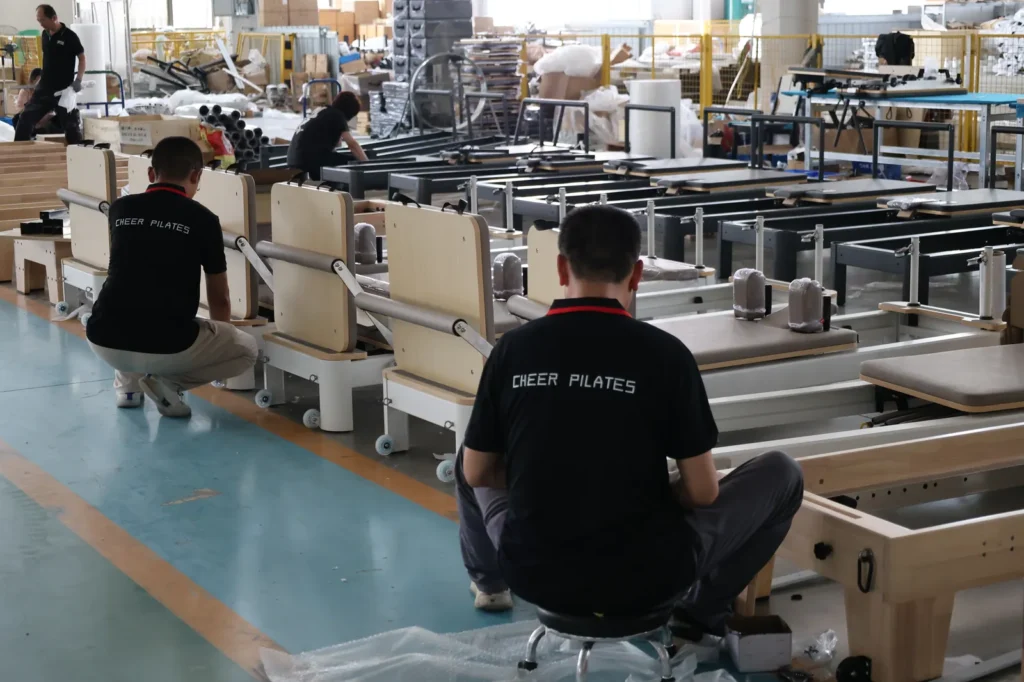
Ask the salesperson to walk the camera through the factory. Don’t accept a pre-recorded tour. Things worth seeing:
- Frames at different stages: raw aluminum profiles or wood parts, welded or joined frames, finished frames
- The upholstery area, where carriage pads and headrests are covered
- Spring storage and the assembly bench, where springs are fitted
- Finished machines being packed into export cartons
- The QC area and any test equipment
You’re not looking for a spotless showroom. You’re looking for work in progress that matches the products you’re buying. If they sell wooden reformers, you should see wood being worked. If they sell aluminum, you should see aluminum frames.
Ask about capacity in numbers
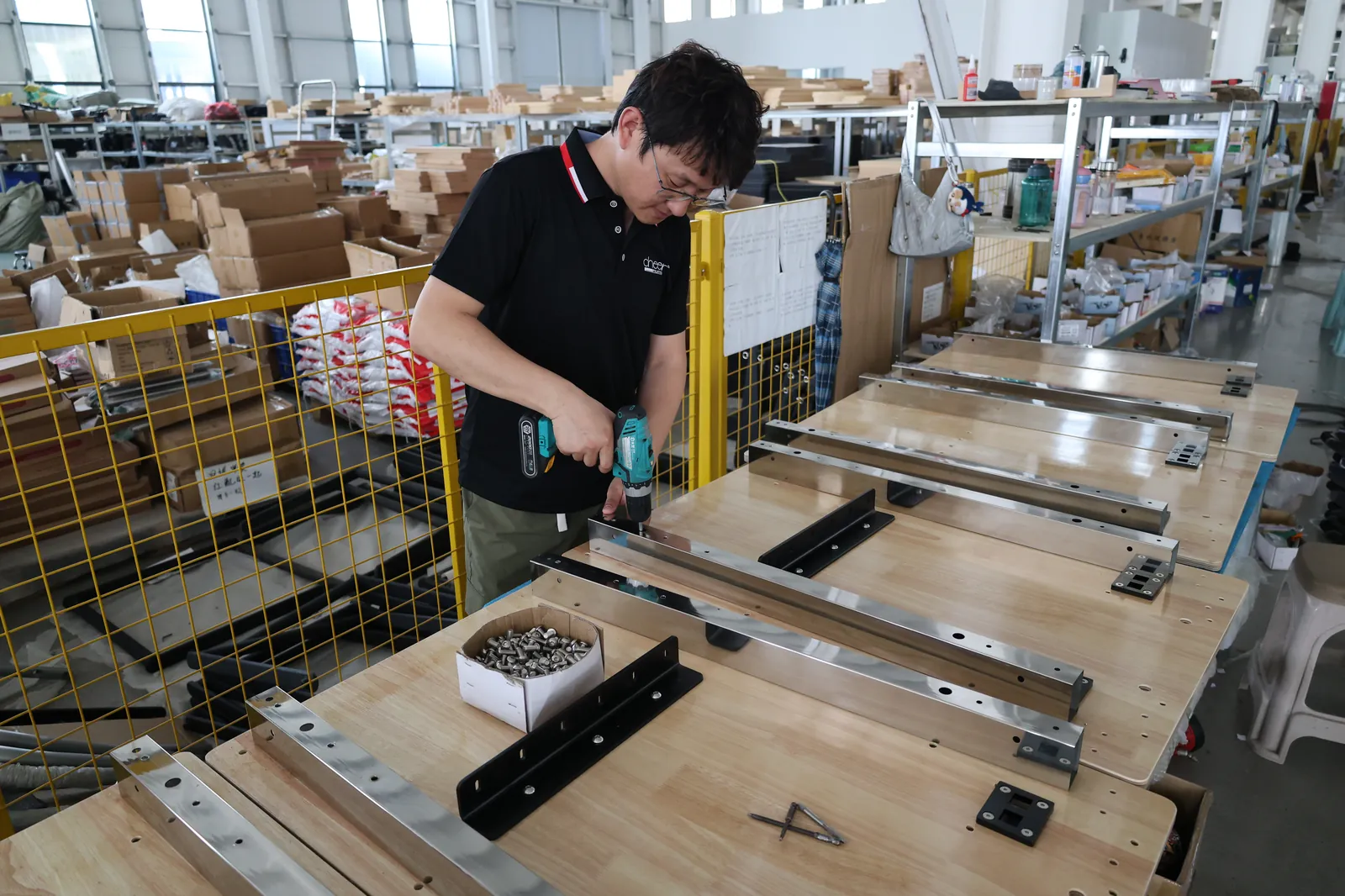
A real factory knows its output. Ask how many units it makes per month and how long your order would take at that rate. Our factory covers 7,500 m², and we produce 2,000–3,000 units a month across our product range. If a supplier gives you a vague answer or a number that doesn’t fit the size of what you see on camera, that’s worth noting.
Step 3: Check certifications properly
Certifications come up in nearly every first conversation we have with a distributor. They matter, but they’re also easy to misread.
Know the difference between factory and product certificates
An ISO certificate is about how the company runs its quality system. A CE marking is about the product. They answer different questions. Ask which one a supplier has, and ask to see the actual documents, not just a logo on a web page.
Our factory is ISO certified and our products are CE certified. We don’t claim certificates we don’t hold. You’d be surprised how often buyers tell us they’ve seen other suppliers list five or six certification logos without being able to send a single document.
Check the name on the certificate
The company name on the certificate should match the company you’re paying. If it’s a different company, the supplier may be borrowing someone else’s paperwork. For ISO certificates, you can also search the certificate on IAF CertSearch, which lists many accredited certificates.
We send copies of our certificates on request. Our ISO 9001:2015 certificate (No. 18626Q00486R047) was issued by Beijing Kun Biao Certification & Inspection Co., Ltd. and is valid until 31 May 2029.
Step 4: Order a sample before you order volume
This is the step people skip when they’re in a hurry. Don’t. A single sample tells you more than any spec sheet.
What a sample shows you
When the sample arrives, check how the carriage rolls, how the footbar locks, how the springs sound and feel, how the upholstery is stitched, and how the machine was packed. Then put it in a studio and let instructors use it for a few weeks. They will find things you won’t.
We sell standard models from 1 unit, so a sample is just a normal order. You can even put your logo on that single unit, which helps if you want to show it to your own customers. OEM projects with design changes start from 5 units.
What a sample doesn’t show you
One good sample doesn’t prove that unit number 50 will be the same. That’s why the next steps matter: written specs, a clear QC process and a supplier willing to put the details into the contract.
Step 5: Get the commercial terms in writing
Most disputes we hear about between buyers and other suppliers come from terms that were only agreed on chat. Put these in the proforma invoice or contract.
The essentials
- Exact configuration: model, frame finish, upholstery material and color, spring set, accessories
- Quantity and lead time: production time plus transport time
- Incoterm: we offer EXW, FOB, CFR, CIF and DDP. Each one moves cost and risk to a different point. If you’re new to this, read our guide on importing Pilates reformers from China.
- Payment terms and method: for us, card and PayPal are accepted alongside bank transfer. Our usual terms are a 30% deposit to start production and the 70% balance before shipment
- Warranty: what’s covered, for how long, and who pays freight for replacement parts
- Packaging: carton type, protection, shipping marks
On warranty, our standard terms are 1 year on the frame and 1 year on wear parts and consumables, covering manufacturing defects. Distributors can negotiate a frame warranty of up to 3 years. Whatever is agreed, get it written into the quotation, PI or contract. See our FAQ page for details.
Step 6: Watch for these red flags
None of these on its own means a supplier is dishonest. Two or three together, and we’d walk away.
The price is far below everyone else’s. Reformers have real material costs: aluminum or hardwood, springs, bearings, upholstery, packaging. If one quote is dramatically lower, something has been taken out. Ask what.
Nobody can answer a technical question. Ask how the carriage runs on the rail, or what the spring set is. If every answer is “no problem, we can do”, you’re probably not talking to anyone near the production line.
The specs change between messages. If the size or weight in the quote doesn’t match the website, ask which is right. Do it before paying, not after delivery.
They won’t do a video call. In 2026 there’s no good reason for a manufacturer to refuse.
Pressure to pay today. Real factories have busy seasons, but they don’t need your deposit in the next hour.
Step 7: Think about the relationship after delivery
The first order is the easy part. What matters over years is spare parts, consistency between batches, and how problems get handled.
Ask a supplier how they handle a broken part found on arrival. Ask if spare springs, ropes and upholstery can be ordered separately. Ask who your contact will be after the sale. At our company, the sales manager who quotes your order stays your contact afterwards, so you don’t have to explain your project twice.
A note on choosing between Chinese suppliers and others
China isn’t the right source for everyone. If you need only two or three reformers delivered next week, a local distributor with stock is probably better, even at a higher price. Buying direct from a factory makes most sense when you’re equipping a full studio, building a distributor range, or want your own logo and colors. That’s the kind of customer we’re set up for.
Frequently asked questions
How can I tell if a Chinese Pilates supplier is a factory or a trading company?
Ask for the business license, check that the company name matches the invoice and bank account, and request a live video tour of the production floor. A factory will show you frames being built. A trader usually can’t.
What is the minimum order quantity for Pilates reformers from China?
It varies by supplier. At Cheer Pilates Equipment, standard models start from 1 unit, logo customization is possible on 1 unit, and OEM projects with design changes start from 5 units.
Which certifications should a Pilates reformer manufacturer have?
Look for a factory quality system certificate such as ISO and product conformity such as CE for markets that require it. Ask for the documents and check that the company name on them matches your supplier.
Should I order a sample first?
Yes. Test it in a real studio for a few weeks before placing a volume order. One sample can’t prove consistency, though, so also agree written specs and QC checks for the main order.
Can I pay by card or PayPal?
With us, yes. Card and PayPal are accepted. Whatever the method, make sure the payee name matches the company on your contract.
How long does shipping from China take?
On our CP101A product page we list sea freight at around 25–45 days to the destination port and air freight at 7–15 days, depending on destination. Production time comes on top of that: about 30 days after deposit for standard models, and about 20–45 days for OEM orders.
Talk to us about your project
If you’re comparing Pilates reformer manufacturers right now, send us your shortlist of models and quantities, for example the CP124 aluminum reformer, the CP168 maple reformer or the CP111 mega reformer. We’ll answer the checklist above for our own factory, in writing. Then ask the others to do the same.
You can also read more about our company or see how our OEM and ODM service works.
Tim Wu is Sales Manager at Cheer Pilates Equipment and has worked in the fitness and Pilates equipment industry for 10 years. He handles export projects for studios, distributors and private-label brands, and you can reach him directly on +86 177 5347 9797.