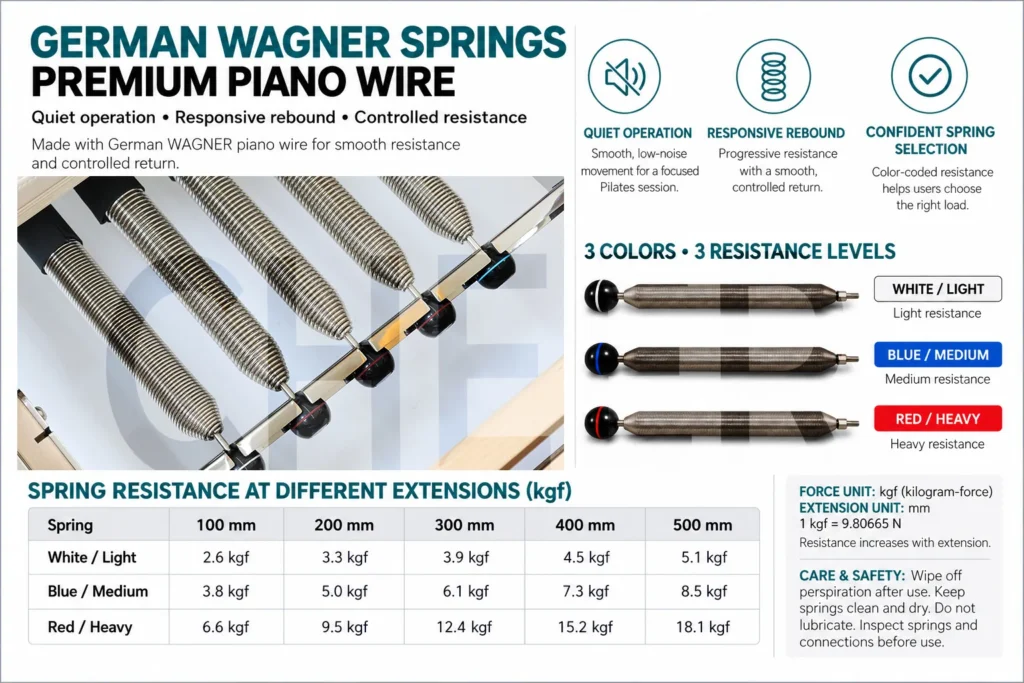
Direct Answer: Pilates reformer springs control the resistance and stability of every exercise, using color-coded tension levels from extra-light (yellow) to heavy (red or green). Commercial studio reformers typically include 5 to 6 calibrated springs—such as German Wagner springs used across all Cheer Pilates Equipment machines—and should be inspected monthly and replaced every 18 to 24 months under heavy group-class traffic (or immediately if coils separate, kink, or show rust).
Whether you are an instructor training new staff, a studio owner budgeting annual maintenance, or a distributor evaluating factory specifications, understanding how reformer springs work—and how to spot commercial-grade wire quality—protects both client safety and machine longevity.
Pilates Reformer Spring Color & Resistance Chart
While exact kilogram tension varies slightly by manufacturer and gearbar position, most commercial studios follow a standardized color progression from lightest to heaviest:
| Spring Color | Relative Tension | Typical Studio Use | Common Set (5–6 Springs) |
|---|---|---|---|
| Yellow | Extra-Light (approx. 1/4–1/2) | Core instability, balance work, shoulder rehab, fine control | 1 yellow |
| Blue | Light / Medium-Light (approx. 1/2) | Arm work, unilateral leg tracking, beginner assistance | 1 blue |
| Green | Medium / Medium-Heavy (approx. 3/4–1) | Footwork transitions, rowing, moderate lower-body resistance | 1 green (optional in 6-spring sets) |
| Red | Heavy (Full / 1.0) | Footwork, leg press, heavy jumpboard and athletic conditioning | 2–3 red |
Note for studio buyers: When comparing factory quotes, always confirm the exact spring count included (5 vs 6 springs) and the wire supplier. Two reformers that look identical in photos can feel completely different if one uses inconsistent unbranded wire.
Why Cheer Pilates Uses German Wagner Springs
In a busy commercial studio running 8 to 12 group classes a day, each reformer spring stretches and recoils thousands of times per week. Cheap carbon-steel springs suffer from early metal fatigue—meaning two “red” springs on neighboring reformers end up feeling noticeably different within six months.
- Uniform resistance across your entire fleet: German Wagner spring steel maintains consistent tension curves across every machine in a 10- or 20-reformer studio.
- High fatigue life: Engineered for continuous commercial cycling without permanent elongation or coil gaps.
- Corrosion-resistant finish: Resists sweat and studio humidity—especially critical in coastal or tropical markets when paired with our commercial aluminum reformers.
5 Signs a Pilates Reformer Spring Must Be Replaced Immediately
- Visible coil gaps at rest: When unhooked, coils should sit tightly closed with zero separation. Any permanent gap means the wire has yielded.
- Kinks, bends, or uneven length: Compare matching colors side-by-side; a stretched spring is a snap hazard.
- Surface rust or flaking plating: Corrosion creates micro-fractures that can cause sudden failure under load.
- Worn hooks or deformed eyelets: Inspect the swivel hooks and D-ring attachment points during your monthly reformer maintenance check.
- Noticeably lighter feel or squeaking: Uneven tension disrupts bilateral exercises and signals metal fatigue.
How Often Should Studios Replace Reformer Springs?
For commercial studios running 40 to 60+ hours of classes per week, plan to replace high-use springs (typically red and blue) every 18 to 24 months, or sooner if any of the 5 warning signs appear. Always replace springs in matched sets on the same machine so instructors can cue consistent resistance across the room.
Pro tip for new studio openings: Order 1 to 2 spare spring sets alongside your initial container or LCL shipment—shipping spare springs inside your equipment cartons costs almost nothing compared to urgent air freight later. See our studio opening equipment guide and commercial vs home reformer comparison for full procurement checklists.
Warranty & Fast Spare-Parts Dispatch
Cheer Pilates backs every machine with a 1-year warranty on frames and 1-year warranty on wear parts and consumables (with extended frame warranties available for distributors). For covered warranty parts, we ship replacements by air within 3 days at our cost; after warranty, studios and distributors can order genuine German Wagner replacement springs at direct factory pricing.
Frequently Asked Questions
What do the colors of Pilates reformer springs mean?
Colors indicate resistance strength from lightest to heaviest: yellow is extra-light, blue is light/medium-light, green is medium, and red is heavy. Exact tension varies slightly by gearbar setting and brand.
How long do commercial Pilates reformer springs last?
Under heavy commercial studio use (8–12 classes/day), calibrated German Wagner springs typically last 18 to 24 months. Studios should inspect springs monthly and replace any spring immediately if coils separate or rust.
How many springs come standard on a Cheer Pilates commercial reformer?
Cheer Pilates commercial reformers come with 5 to 6 calibrated German Wagner springs depending on the model, plus additional tower springs on half-tower, full-tower, and Cadillac units.
Can I buy replacement German Wagner springs separately from Cheer Pilates?
Yes. We supply genuine replacement springs, straps, ropes, wheels, and upholstery pads directly from our factory—free air dispatch within 3 days during warranty, and factory-direct pricing after warranty.
Equipping a studio or sourcing replacement springs? Browse our commercial Pilates equipment catalog or contact Cheer Pilates for a factory quote within 12 hours.