By Tim Wu, Sales Manager, Cheer Pilates Equipment
Short answer: Commercial Pilates reformer cost comes down to a few things. The frame material and structure matter most (aluminum, hardwood or steel), then the rail and carriage system, the springs, and the upholstery and foam. On top of that come add-ons like a tower, any customization (logo, color, OEM changes), export packaging and freight. Two reformers that look alike in photos can differ a lot in price because of what you can’t see: bearings, spring quality, frame thickness and how carefully they were assembled and checked.
We don’t publish prices on cheerpilates.com. That’s deliberate. A reformer price without the configuration behind it is almost meaningless, and we’ve seen too many buyers compare a fully equipped studio machine with a stripped-down one and think they found a bargain.
So instead of a price list, this article explains what you’re paying for, part by part. It’s the conversation we have with buyers on almost every first call. Once you know where the cost sits, you can read any quote, ours or someone else’s, and see whether it adds up.
1. The frame: material and structure
The frame is usually the biggest single cost in a reformer. Three things drive it.
Material
We build reformers in aluminum alloy, solid wood (maple, oak, walnut) and steel.
Aluminum is light for its strength and doesn’t rust. That’s why clinics and humid studios often prefer it. The cost depends on the profile: the thickness and shape of the extrusions, and the surface finish. Anodized and powder-coated finishes are priced differently.
Hardwood costs more in labor than in raw material. Wood has to be selected, dried, machined, joined, sanded and finished. Walnut is the most expensive wood option we offer.
Steel is common on our heavier mega reformers, such as the CP118, which weighs 183 kg net. Steel itself is affordable, but welding, finishing and the sheer weight to ship add up.
Structure and size
A longer, wider or taller machine uses more material. Our CP118 mega reformer is 3260 mm long. Our compact CP116 is 2070 mm. They aren’t the same product, and they shouldn’t cost the same.
2. Rail, carriage and bearings
This is where cheap reformers usually cut corners, because you can’t see it in a photo.
The carriage has to roll smoothly and quietly thousands of times a week. That depends on the rail profile, the wheels or bearings, and how accurately everything is aligned during assembly. Better bearings and tighter tolerances cost more. They also make the difference between a machine instructors love and one they complain about after six months.
Our view: if you have to save money, don’t save it here. Pick a simpler upholstery before you pick a cheaper carriage system.
3. Springs
Springs set the feel of the machine. The cost depends on the wire quality, how consistent the resistance is from spring to spring, the number of springs, and the end fittings.
Ask any supplier how many springs come with the machine and what resistance levels they cover. Then compare like with like. A quote with four springs and a quote with six aren’t the same machine. Our standard reformers come with 5–6 springs, and we use German Wagner springs.
4. Upholstery and foam
Carriage pads, headrests, shoulder rests and the foot platform all need foam and a cover. Options we offer include microfiber leather and, on some models, a skin-feel silicone cover, with EVA or high-density foam underneath.
Better covers last longer under sweat and daily disinfecting. Denser foam keeps its shape for longer. Stitching quality matters too. Poor stitching is the first thing that fails in a busy studio.
5. Adjustable parts
Every adjustable part has a mechanism: footbar, headrest, rope risers, shoulder rests. More positions and better locking mean more machined parts and more assembly time.
Our CP101A, for example, differs from our CP101 mainly in its reworked front footbar, which adjusts faster and locks more firmly. That upgrade adds cost. Whether it’s worth it depends on how often your instructors adjust the footbar. In a busy group studio, it usually is.
6. Towers and add-ons
A tower adds a frame, a push-through bar, more springs and accessories. It also adds packing volume. Compare our CP124 aluminum reformer (2490 × 695 × 425 mm) with our CP310, which is the same base with a half tower and stands 2015 mm tall. The CP310 ships at 1.16 CBM and 160 kg gross.
Other add-ons that move the price:
- Sitting boxes and jump boards
- Extra straps, handles and loops
- Full-tower or Cadillac conversions
7. Customization and OEM
Customization covers a wide range, and the cost depends on how far you go.
Logo only. Printing or engraving your logo is usually a small add-on. We can do it from 1 unit.
Color and materials. With us, a custom upholstery color is possible from 1 unit, and a custom frame color from 5 units.
OEM design changes. Changing dimensions, parts or packaging design is a real engineering job. Our OEM projects start from 5 units.
The more you change, the more setup work there is. On larger orders that cost is spread across more units.
8. Quality control
A factory that inspects every machine before packing spends time and labor on it, and that’s part of the price. A factory that skips inspection is cheaper. You find out the difference when the cartons arrive.
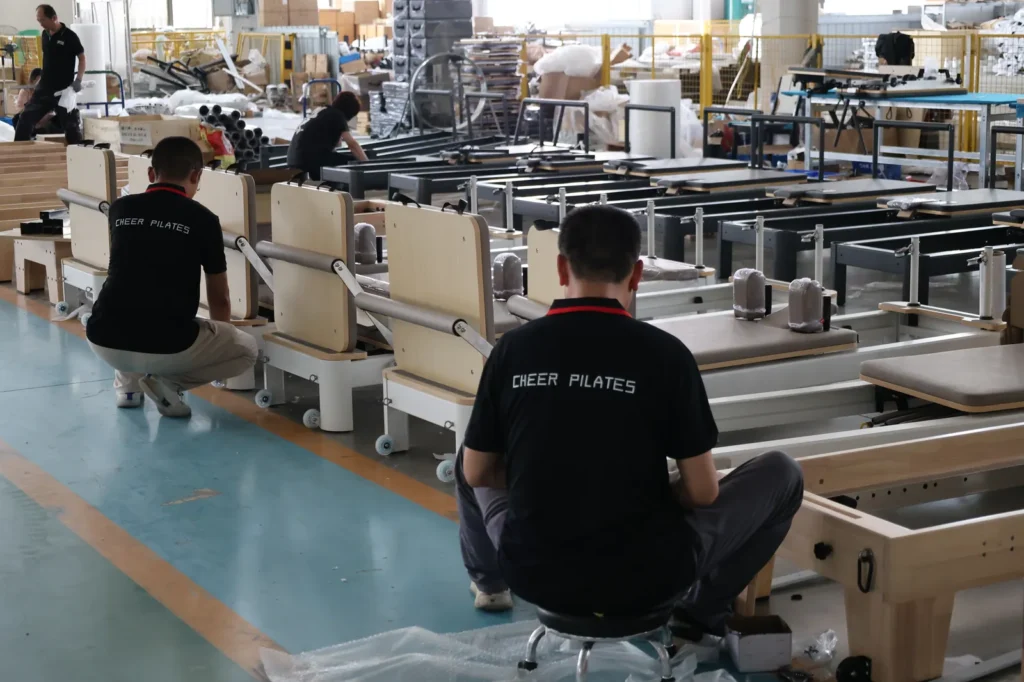
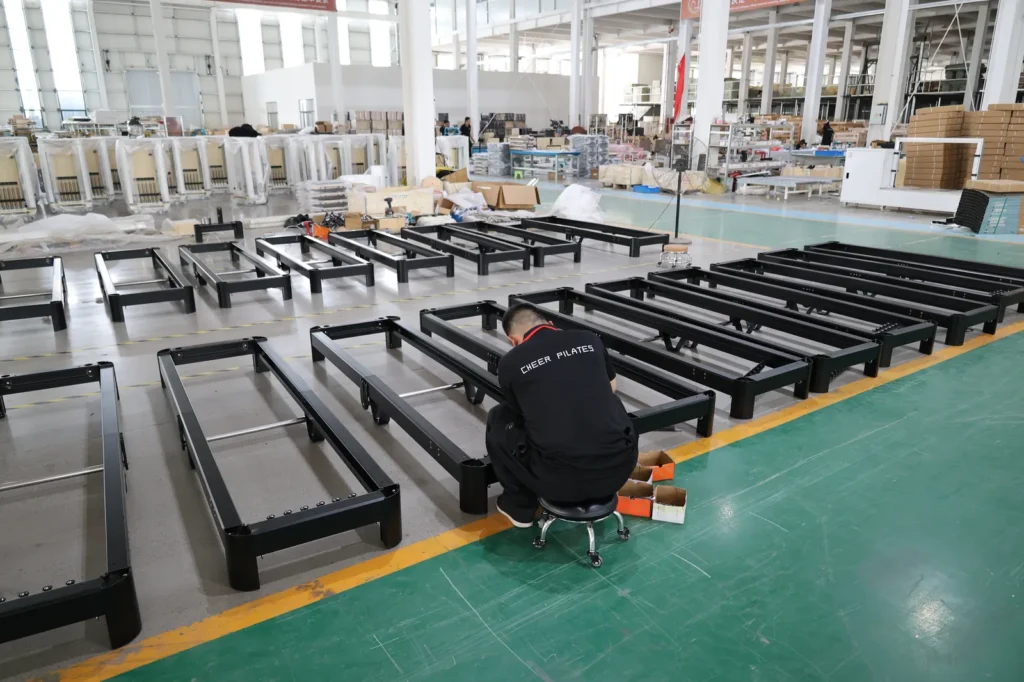
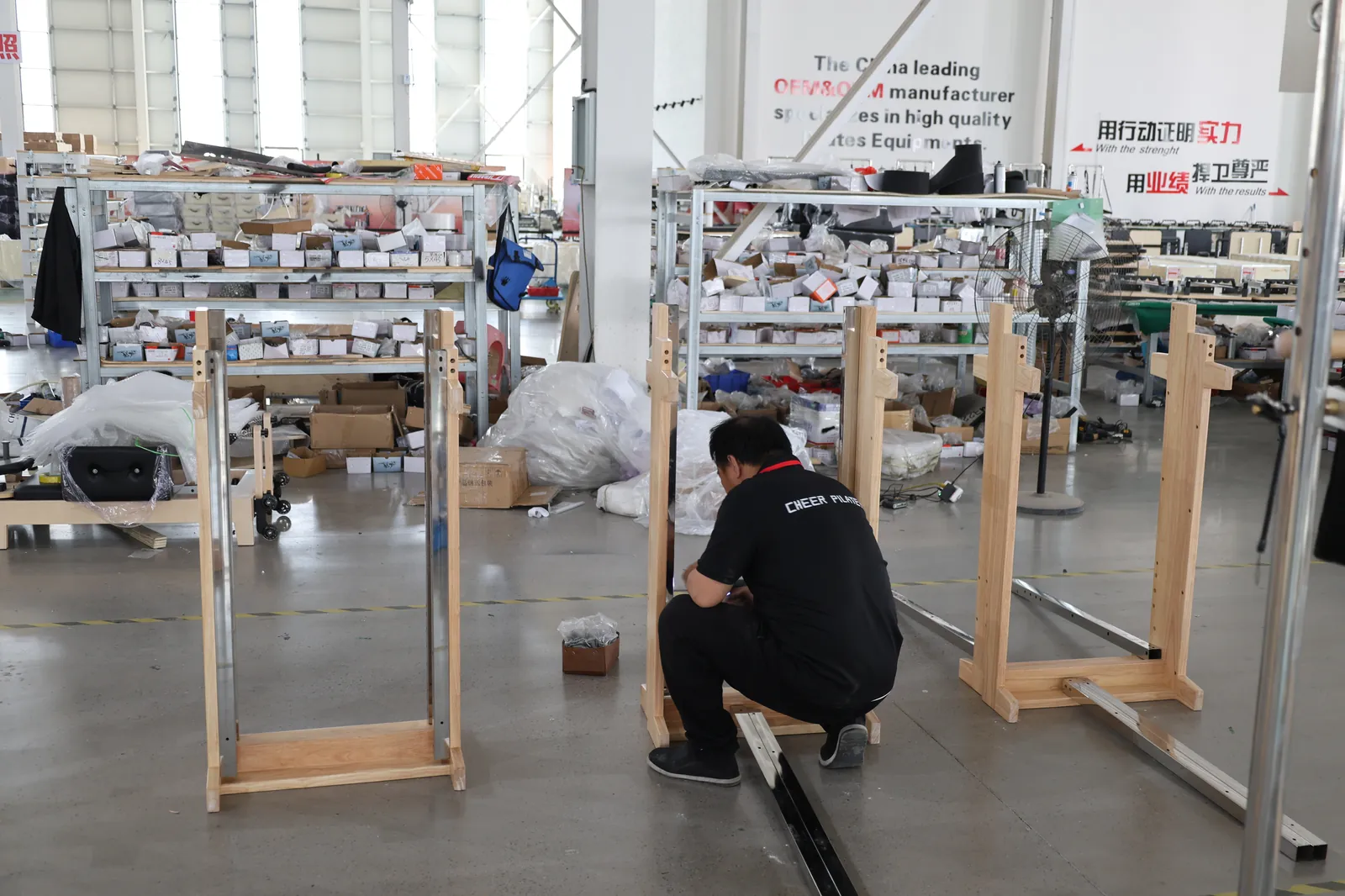
At our factory in Ningjin, every reformer is inspected before it’s packed.
9. Packaging
Export packaging protects the machine for a 25–45 day sea journey and several rounds of handling. Stronger cartons, corner protection, foam and wood frames cost more, but they’re cheap compared with a damaged reformer.
Some of our folding models ship partly in a wooden case. Our CP221, for example, includes a wooden case in its packing.
10. Freight and import costs
Freight is charged mostly by volume and weight. That’s why packing size matters so much. A reformer that packs into 0.6 CBM, like our CP201 folding reformer, costs less to ship than one at 1.4 CBM.
After freight come insurance, import duties and taxes, port charges and delivery. Your shipping term decides which of these are in our quote and which you pay separately. We offer EXW, FOB, CFR, CIF and DDP.
11. Order size
Larger orders lower the cost per unit, mostly because setup, customization and packing work are spread across more machines, and container space is used better. That said, we sell standard models from 1 unit, and starting with one is a sensible way to test a machine before you commit.
Where buyers overpay, and where they underpay
Overpaying: paying for features your studio won’t use. A rehab clinic with mostly older clients may not need a jump board on every machine. A small studio may not need towers on every station. Sometimes two tower machines and four plain reformers are a better mix.
Underpaying: saving on the carriage, springs or upholstery. These are the parts clients feel every session, and the parts that wear out first.
How to compare commercial Pilates reformer cost across quotes
Before you compare two quotes, make sure they cover:
- The same model type and size
- The same frame material and finish
- The same number of springs and the same accessories
- The same upholstery and foam
- The same customization
- The same shipping term (DDP vs FOB makes a big difference)
- The same warranty terms
If any of these differ, you’re comparing different products.
Frequently asked questions
Why don’t you publish reformer prices on your website?
Because the price depends on configuration, customization, quantity and shipping term. A list price without those details would mislead more buyers than it helps. Send us your requirements and we’ll quote that exact configuration.
Is an aluminum or wooden reformer more expensive?
It depends on the model and finish. Hardwood reformers involve more hand work. Aluminum costs depend on the profile and finish. Our aluminum vs wood guide explains the trade-offs beyond price.
Does adding my logo increase the price a lot?
Usually not much. Logo customization is available from 1 unit. Bigger changes, like custom dimensions, are OEM projects and start from 5 units.
How much does shipping add?
It depends on packing volume, weight, destination and shipping term. Our product pages list packing sizes and weights so you or your forwarder can estimate freight.
Do larger orders get a lower unit price?
Generally, yes. Setup, customization and packing costs are spread across more units, and container space is used more efficiently.
Ask for a quote on your exact configuration
The quickest way to understand commercial Pilates reformer cost is a quote on your own configuration. Tell us the models, quantities, finishes and destination. We’ll break down the quote so you can see where the cost sits.
You can also browse all our products, see the OEM and ODM service, or request a custom quote.
Tim Wu is Sales Manager at Cheer Pilates Equipment and has worked in the fitness and Pilates equipment industry for 10 years. He handles export projects for studios, distributors and private-label brands, and you can reach him directly on +86 177 5347 9797.