By Tim Wu, Sales Manager, Cheer Pilates Equipment
Short answer: Most new Pilates equipment distributors do best in four steps. Order one or two sample machines, with your logo if you want it, and get them in front of real studios. Then choose a small core range of three to five models. Place a mixed first order sized to your cash flow and storage. Move to OEM or private-label changes only once you know what sells. At Cheer Pilates Equipment, standard models start from 1 unit, logo branding is available from 1 unit, and OEM projects start from 5 units. If you plan to work with us long term, see our Pilates equipment distributor program.
Distributors come into Pilates from different directions: gym equipment dealers adding a new category, physiotherapists supplying other clinics, studio owners who end up supplying their peers.
Whatever the background, the first order is the hardest. You’re putting money into heavy, bulky stock in a market you’re still learning. This guide is how we’d approach it if we were on your side of the table.
Step 1: Know who you’re going to sell to
Before choosing products, decide who your buyers are. The range you need depends on it.
Boutique and group studios usually want reformers first, often several of the same model, and care about looks and consistency.
Physio and rehab clinics often want lower working heights, towers or Cadillacs for assisted exercises, and frames that handle constant cleaning.
Gyms and hotels often want a small Pilates corner: a few reformers, a chair, maybe a barrel. Durability and easy maintenance matter more than design.
Home users are a different business, with lots of small deliveries and more customer service per unit. Many distributors avoid this at first.
Some start as customers. A studio owner in Thailand bought a CP152 oak reformer, a CP322 oak full tower, a CP501 Wunda Chair and a CP521 Ladder Barrel for their own studio. After everything arrived safely and in good condition, they told us they were thinking about importing Pilates machines for sale, or becoming our representative, once their current business was settled.
Step 2: Start with samples, not a container
We sell standard models from 1 unit, so a sample order is just a small normal order. This is the cheapest market research you can buy.
What to do with samples
- Put them in a partner studio for a few weeks and ask the instructors for honest feedback
- Use them for photos and videos in your own marketing
- Show them at local events or open days
- Test your delivery and installation process before you have to do it 20 times
Branding on samples
We can add your logo even to a single unit. That helps if you want studios to see “your” product rather than ours. It also lets you check how your logo looks on the frame before a larger order.
Step 3: Build a small core range
New distributors often try to offer everything. Don’t. A focused range is easier to sell, easier to stock and easier to support.
A practical starting range
From our catalogue, a starter range might look like this. Change it to fit your market:
- One aluminum reformer for clinics, gyms and humid regions, for example the CP124
- One wooden reformer for boutique studios and hotels, for example the CP167 maple reformer
- One reformer with a tower for studios that want more programming, for example the CP310 aluminum half tower or CP301 maple half tower
- One chair for small add-on sales, for example the CP501 oak stability chair (30 kg net, 0.46 CBM packed)
- Spare parts: springs, ropes and upholstery parts
Add Cadillacs, mega reformers and rotational movement equipment later, once you have project buyers asking for them.
Our honest view on range size
Three to five models you know well will sell better than twenty you can’t explain. Your customers will ask detailed questions. You need to answer them.
Step 4: Decide what to stock and what to make to order
This is a cash-flow decision.
Stock the models that sell steadily and need fast delivery, usually your main reformer and a few spare parts.
Make to order anything with custom colors, towers, Cadillacs and large project orders. Studios opening a new location usually plan months ahead, so they can wait for production and shipping.
Keep in mind the transport time: roughly 25–45 days by sea to the destination port and 7–15 days by air, depending on destination. Production comes first: about 30 days after deposit for standard models, about 20–45 days for OEM orders.
Step 5: Plan your first mixed order
Think in CBM, not units
Freight cost depends on volume and weight. Use packing sizes from each product page to estimate how much space your order takes. A few examples from our range:
| Model | Packed volume | Gross weight |
|---|---|---|
| CP310 aluminum + half tower | 1.16 CBM | 160 kg |
| CP302 oak + half tower | 0.96 CBM | 137 kg |
| CP201 folding aluminum reformer | 0.6 CBM | 100 kg |
| CP501 oak stability chair | 0.46 CBM | 43.5 kg |
| CP364 maple core ladder | 0.52 CBM | 90 kg |
Smaller items like chairs and barrels can fill gaps around reformers in a container.
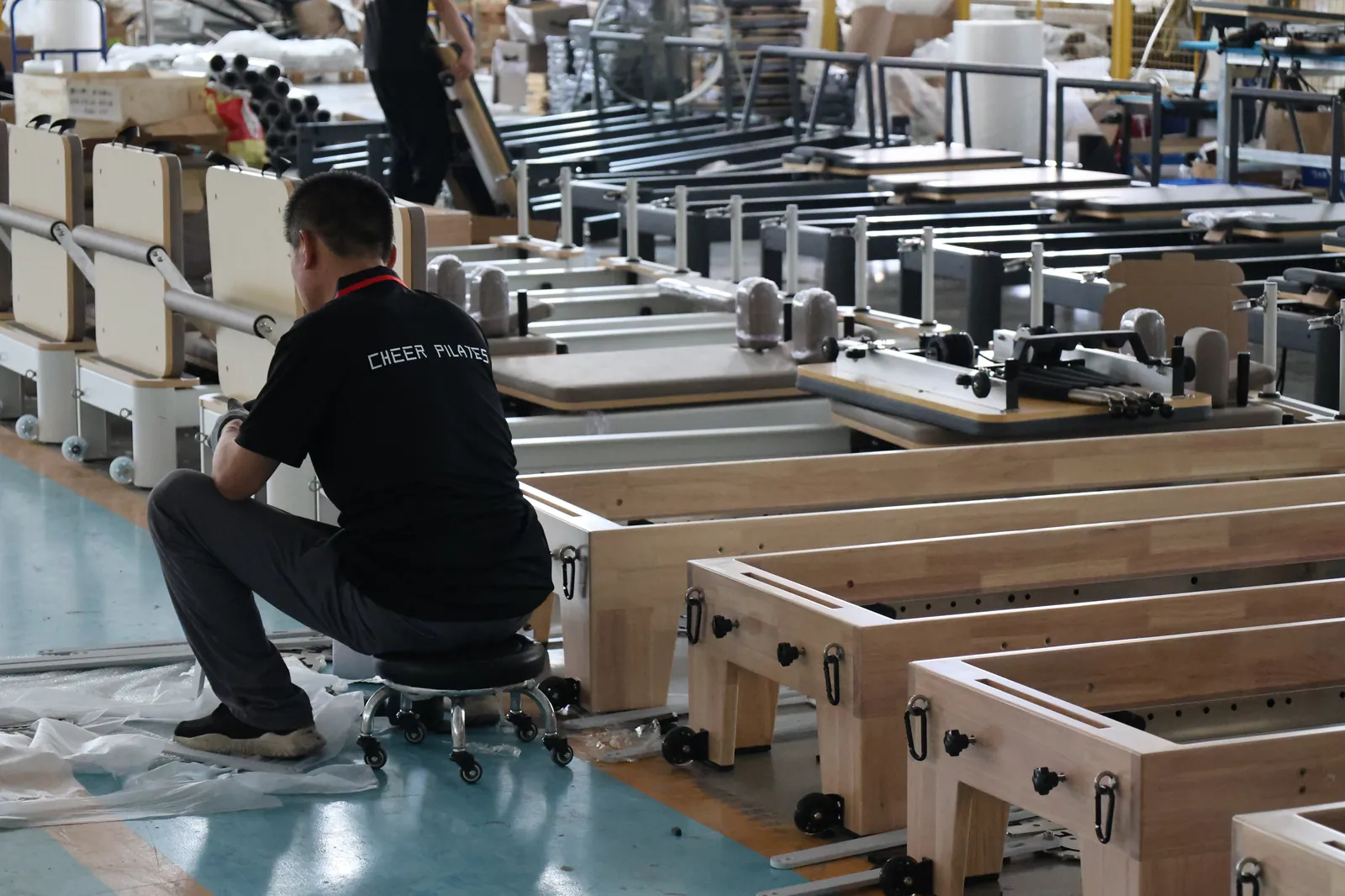
As a typical loading for single models: about 24 CP101 aluminum reformers in a 20GP and 60 in a 40HQ, or about 36 CP201 folding reformers in a 20GP and 100 in a 40HQ. A mixed order changes these numbers, so we plan the loading for each order. Our classic wooden reformers CP151 and CP152 load at about 24 units in a 20GP and 60 in a 40HQ. Crates are stacked up to 4 layers high.
Choose your shipping term
We offer EXW, FOB, CFR, CIF and DDP, the standard Incoterms rules. If this is your first import, DDP keeps it simple. If you already have a forwarder in China, FOB (or EXW, if they collect from factories) may be cheaper overall. See our guide to importing Pilates reformers from China for details.
Step 6: Move to private label when you’re ready
Once you know which models sell, you can make them yours.
Logo branding (from 1 unit): your logo on the frame or upholstery.
Colors and materials: custom RAL frame colors, upholstery colors and wood finishes.
OEM changes (from 5 units): configuration changes, accessory packages, packaging design and product adjustments for your market.
Our OEM and ODM service page explains the process in more detail. We’d suggest waiting until your second or third order before making major design changes. By then you’ll know what your customers really ask for.
Step 7: Plan after-sales before you need it
Distributors are judged on after-sales, not on the first delivery. Think about:
- Spare parts stock: springs, ropes and loops, and a few upholstery pieces
- Who installs: you, a partner or the customer
- Warranty process: how a customer reports a problem and how you get parts from us
Our standard warranty is 1 year on the frame and 1 year on wear parts and consumables, covering manufacturing defects under normal use. For distributors, we can negotiate a frame warranty of up to 3 years, depending on the cooperation terms, and we put the final terms in the distributor agreement. During the warranty period, qualified replacement parts are air-shipped free of charge. After the warranty period, we still supply replacement parts at factory prices.
What do we look for in a long-term partner?
We’re happy to sell one unit to anyone. For longer-term distributor cooperation, it helps when partners:
- Know their local market and customer types
- Can handle delivery and basic installation
- Give us honest feedback on what works and what doesn’t
- Plan reorders a little ahead, especially before busy seasons
In return, you get a factory contact who stays the same, product data you can use in your marketing, and a factory with 2,000–3,000 units of monthly capacity to grow with. Our factory is ISO certified, and our products are CE certified.
Common mistakes we see
Starting too big. A full container of one model before testing the market.
Too many models. Twenty SKUs and no idea which one to recommend.
Forgetting the last mile. Reformers weighing 120–150 kg packed need the right truck and two people.
No spare parts. A studio with one broken spring waits six weeks. That’s a lost customer.
Comparing quotes on different terms. An FOB quote next to a DDP quote isn’t a fair comparison.
Frequently asked questions
What is the minimum order to become a Pilates equipment distributor?
There’s no minimum to start working with us. Standard models can be ordered from 1 unit, logo customization is available from 1 unit, and OEM projects start from 5 units.
Can I get my own brand on the equipment?
Yes. Logo branding is available from 1 unit. Custom colors, upholstery, accessories and packaging can be set up too, and deeper OEM changes start from 5 units.
Should I order samples before a bulk order?
Yes. Samples let you check build quality, show the product to studios and test your delivery process. It’s the least expensive way to reduce risk.
Which products should a new distributor start with?
Usually one aluminum reformer, one wooden reformer, one tower reformer and a chair, plus spare parts. Adjust the mix to your main customer type.
Do you offer exclusive distribution?
Yes, exclusive distribution is available. Tell us about your market and your plans, and we’ll discuss it with you.
How do I pay for my first order?
We accept credit card and PayPal, as well as bank transfer. Our usual terms are a 30% deposit to start production and the 70% balance before shipment.
What should you do next?
If you’re planning to become a Pilates equipment distributor, tell us your country, your target customers and the models you’re interested in. We’ll suggest a starting range and a first-order plan that fits your budget.
See the distributor program, browse all products, or read about our company.
Tim Wu is Sales Manager at Cheer Pilates Equipment and has worked in the fitness and Pilates equipment industry for 10 years. He handles export projects for studios, distributors and private-label brands, and you can reach him directly on +86 177 5347 9797.